Beyond Keywords: Mastering AI Content Optimization for Google and Beyond




AI Content Optimization is the practice of structuring and refining your content so search engines and AI-powered answer engines can easily extract, understand, and cite your information. Unlike old-school keyword stuffing, this modern approach focuses on semantic clarity, contextual depth, and creating "citation-worthy" content that AI systems confidently reference when answering user queries.
Here's what AI Content Optimization involves:
The stakes are high. With over 7 million blog posts published daily and AI search platforms growing 800% year-over-year, your content must be structured for AI comprehension to remain visible. This shift to AI-first optimization is about survival. AI systems process millions of pages daily with tight timeouts of 1-5 seconds per page. If your content is slow or poorly structured, AI will skip it. Content with specific data points is 30-40% more likely to appear in AI responses, and an authoritative tone makes you up to 30% more likely to get cited.
For agency owners, this presents a major opportunity. While the manual work of creating AI-optimized content can be overwhelming, the rewards are substantial. Companies using these strategies have seen traffic increases of 187% and conversion rate improvements of 68%.
I'm Hansjan Kamerling, and I've spent years helping startups scale with strategic AI Content Optimization. In this guide, I'll show you how to implement these strategies without losing the human creativity that makes content valuable.
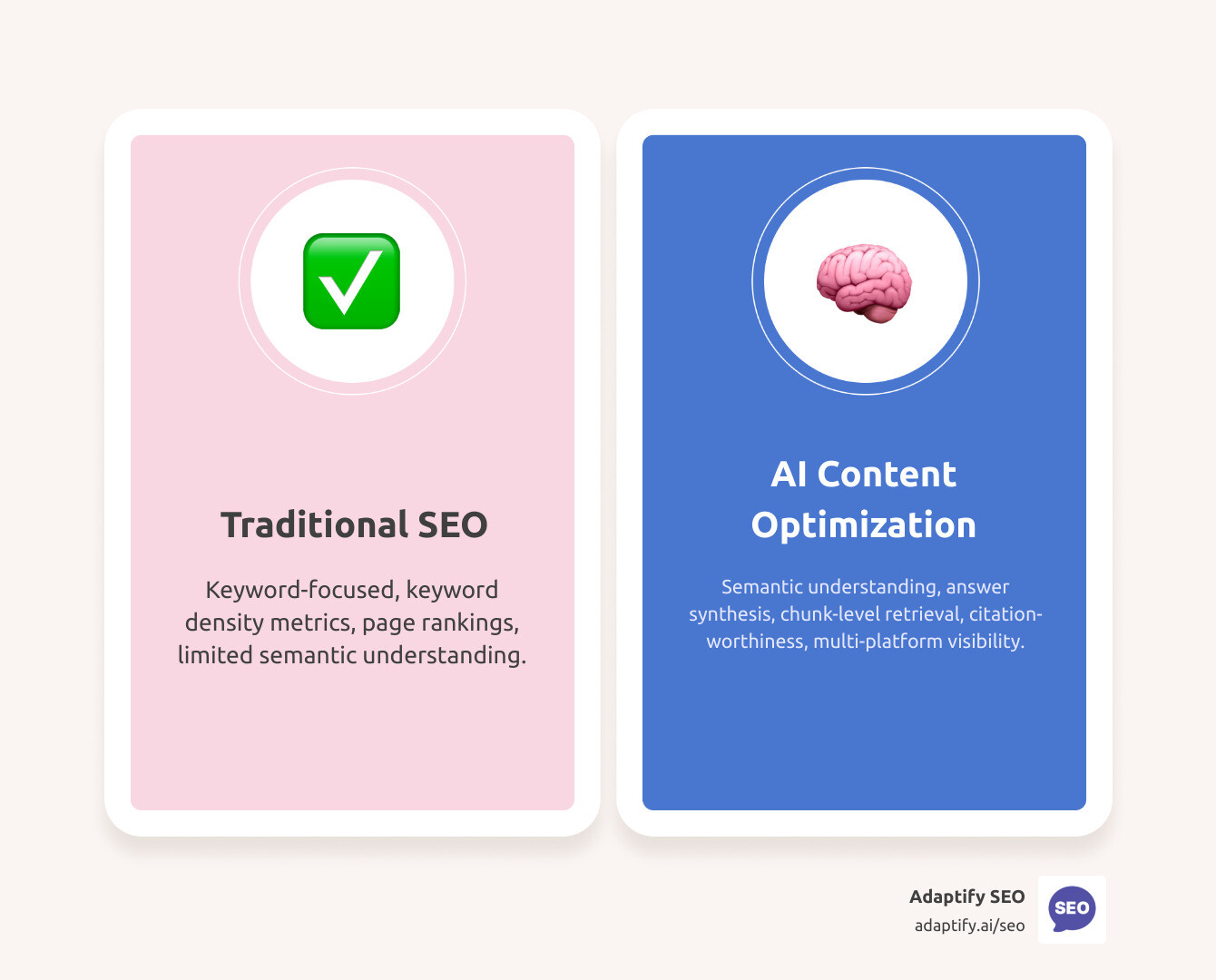
The traditional "ten blue links" of search are giving way to a more sophisticated AI-driven paradigm. If you're not optimizing for it, you're becoming invisible to a growing audience.
AI Content Optimization recognizes that AI systems don't just match keywords—they understand, synthesize, and present information in new ways. Instead of just showing pages that might have an answer, AI systems generate the answer, citing the most trustworthy sources. We're no longer just competing to rank; we're competing to be the source AI trusts enough to cite.
As Harvard Business Review notes, it's time to Forget What You Know About SEO. Think of it this way: AEO is your strategy, while GEO is your execution.
Answer Engine Optimization (AEO) is the strategic framework. It's based on the truth that AI can't surface what it doesn't understand. AEO is about structuring content so AI can interpret, summarize, and confidently cite it.
Generative Engine Optimization (GEO) is the tactical execution. It focuses on semantic clarity, contextual depth, and AI-readable formatting to make every piece of content as extractable and citation-worthy as possible.
The key difference is the result. Traditional search gives you a ranked list. AI search synthesizes a direct answer with citations. Your goal is to be understood and cited.
| Feature | Traditional SEO | AI Search Optimization (AEO/GEO) |
|---|---|---|
| Retrieval Style | Single-query match with pages | Query fan-out and content synthesis |
| Optimization Target | Page content and metadata | Content chunks and factual spans |
| Results Presentation | Ranked list of clickable links | Synthesized answer, citations, summaries |
| Success Metrics | Rankings, CTR, traffic | Inclusion/visibility in response, citations/mentions |
| Content Format Focus | Keyword density, readability for humans | Semantic clarity, extractability, authority, data points |
| Query Behavior | Short, keyword-based queries | Long, conversational, multi-turn, task-oriented queries |
Being cited in an AI answer may send less direct traffic than a top ranking, but it establishes your brand as an authority in a way blue links never could.
Understanding how AI differs from traditional search is the foundation of effective AI Content Optimization.
The biggest shift is chunk-level retrieval. AI systems don't index whole pages; they break content into smaller passages or "chunks," analyze each one, and pull the most relevant pieces to synthesize an answer. This means each section of your content must stand on its own and make sense out of context. Dense, meandering text is kryptonite for AI.
Speed is another critical factor. AI systems process 30-50 million pages daily but have timeouts of just 1-5 seconds per page. A slow-loading site means your content gets ignored. Key information must load quickly and appear early in the HTML.
Finally, there's the JavaScript rendering challenge. Many AI crawlers, unlike Google's Gemini or AppleBot, don't render JavaScript. If your essential content relies on client-side JS, it may be invisible to them. AI crawlers are also less efficient than Googlebot, with a higher failure rate. You can learn more about AI crawlers and their challenges.
The lesson is simple: brilliant content that AI can't access or understand might as well not exist. Technical foundations matter as much as the words themselves.
Now that we understand the "why," let's dive into the "how." Effective AI Content Optimization requires a systematic approach covering four key areas: technical foundations, content structure, authority signals, and user experience.
If AI crawlers can't read your content, nothing else matters. The foundation is clean HTML and fast load times. With AI crawlers having brutal 1-5 second timeouts, your core content must be visible in under one second.
Your robots.txt configuration must explicitly allow AI crawlers. Welcome major players like GPTBot, Google-Extended, bingbot, ClaudeBot, CCBot, and PerplexityBot. You can find technical details in Google's AI crawler documentation. Also, ensure security tools like Cloudflare don't inadvertently block these legitimate bots by whitelisting their IP ranges.
For sites heavy on client-side rendering, implement server-side rendering to ensure AI bots see a fully formed page. Use canonical tags to prevent confusion from duplicate content.
Once accessible, your content must be understandable. This is where strategic structure turns good content into citation-worthy content.
Adopt an answer-first approach. Put your main answer at the top in 1-2 clear sentences (30-50 words). This "bottom line up front" style lets AI immediately grab your core message.
Use headings that are questions people ask, like "What are the benefits of AI content optimization?" This helps generative engines reuse your content to answer similar queries.
Break content into short, focused paragraphs (75-300 words, 2-4 sentences each). Each chunk should address one clear idea, making it modular and extractable. Peer-reviewed studies show that clarity wins, recommending simple language and sentences of 15-20 words.
Organize content into topic clusters: a central pillar page linking to supporting pages on specific subtopics. This structure, which we use at Adaptify.ai, establishes topical authority for both users and AI. You can learn more about our content services and how we implement this. Finally, plan for follow-up questions by addressing the natural next steps within your content.
Schema markup is your direct hotline to AI systems, providing explicit semantic clues about your content. Using JSON-LD format, you tell AI engines what your content means, not just what it says.
The most valuable schema types for AI Content Optimization are FAQ schema for Q&A sections, HowTo schema for guides, Product schema for e-commerce, and Organization/Person schema to establish authorship. Implementing schema dramatically increases the chance of being accurately understood and cited. Google's documentation on structured data offers comprehensive guidance.
For your content to be cited, it must demonstrate Expertise, Authoritativeness, and Trustworthiness (E-E-A-T).
By prioritizing these signals, you build a reputation that AI systems can confidently rely on.
Let's get practical. This is your field guide for implementing AI Content Optimization and proving its value.
You can't improve what you don't measure. Here's how to track the impact of AI Content Optimization.
Smart implementation, careful measurement, and continuous refinement are what make AI content optimization successful.
Here are answers to common questions about implementing AI Content Optimization.
AI is a game-changer for localization and global reach.
AI is an excellent assistant for making content more digestible and inclusive.
A one-size-fits-all approach to AI Content Optimization fails because different formats and platforms have unique requirements.

The journey into AI Content Optimization isn't about replacing creators with robots. It's about a powerful partnership where human creativity meets AI efficiency. AI handles the heavy lifting—data analysis, pattern recognition, and repetitive tasks—while you focus on strategic thinking, creative storytelling, and understanding your audience.
We've covered the building blocks of a future-proof content strategy: how AI processes information, the importance of technical foundations, structuring content for comprehension, and building authority signals. These are the practical steps to thrive in a landscape where AI search is growing 800% year-over-year.
For agency owners, this shift is a unique opportunity. Your clients need guidance on AI search visibility, and mastering AI Content Optimization now will position you as an industry leader.
If you're looking to streamline your SEO processes and deliver exceptional results, my team at Adaptify.ai has built automated SEO solutions for this new era. We've designed tools that reduce manual effort while amplifying impact, helping you master optimization for Google, ChatGPT, Perplexity, and beyond.
Explore our comprehensive SEO solutions and find how we can help you turn this challenge into your competitive advantage. The future of content is collaborative, strategic, and it starts now.
Master localized SEO to rank your local business in Google Maps and drive more in-store visits.

Master local retail SEO to drive foot traffic from Google with proven strategies for GBP, reviews, and AI search optimization.

Learn how to build a clean off-page SEO proposal that wins clients without raising red flags, using white-hat digital PR and transparent l...
Join 1,000+ agencies already delivering SEO and AI visibility from a single platform without increasing their headcount.Join 1,000+ agencies already delivering SEO and AI visibility from a single platform without increasing their headcount.