Beyond Manual: Streamlining Your Marketing with Content Automation

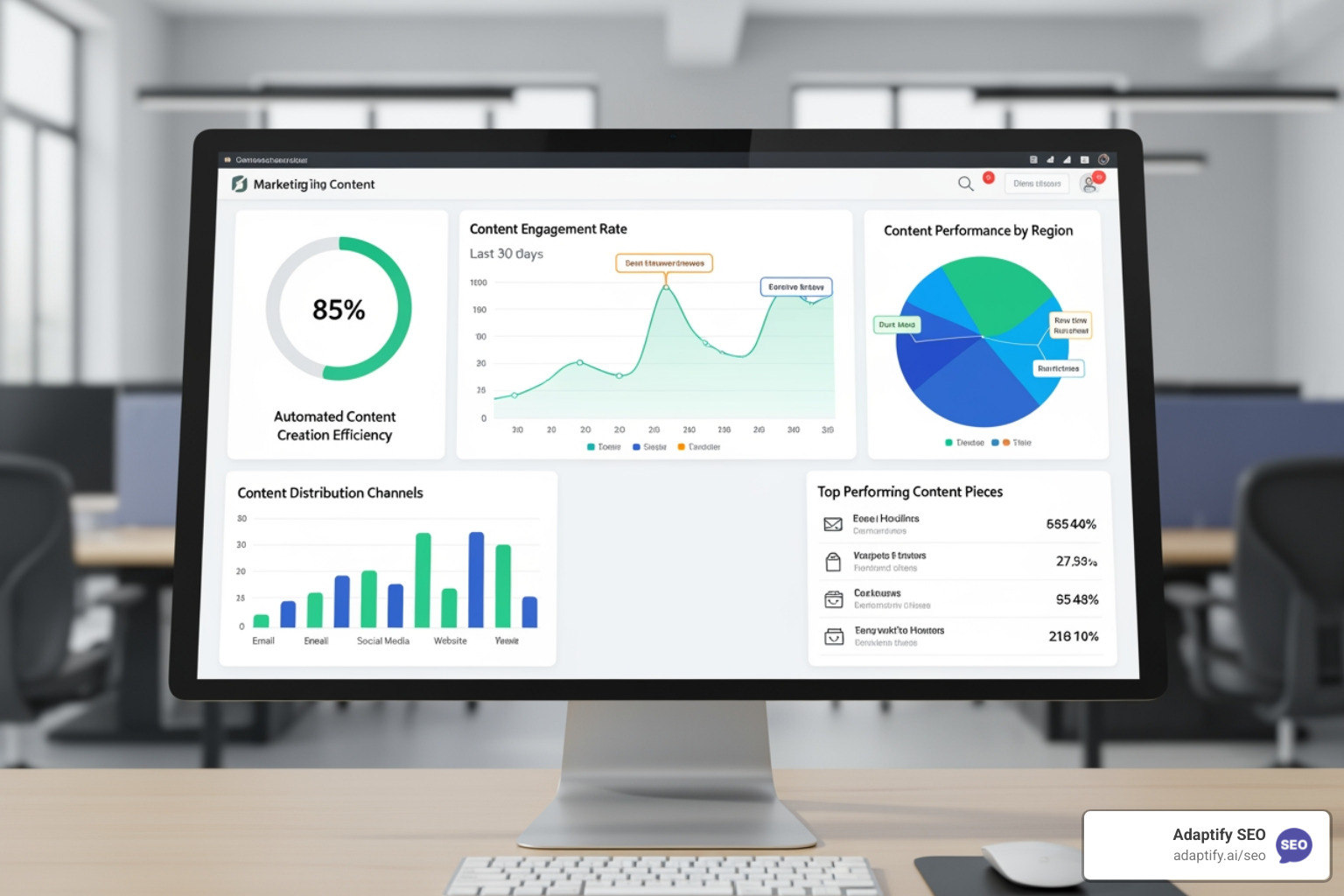

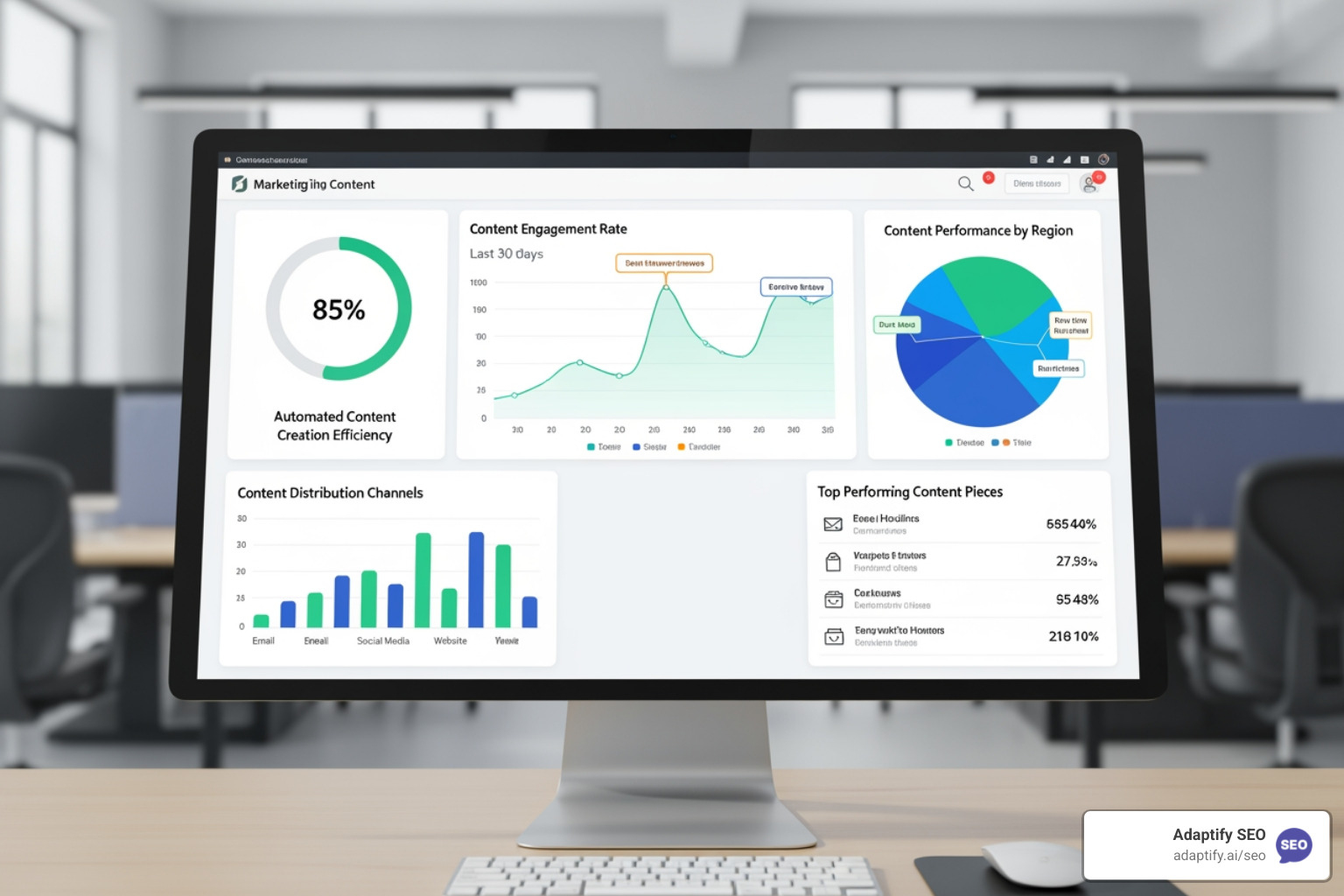
Marketing content automation is the use of AI-powered tools and software to streamline, optimize, and scale the entire content lifecycle—from ideation and creation to distribution and performance tracking—without constant manual intervention.
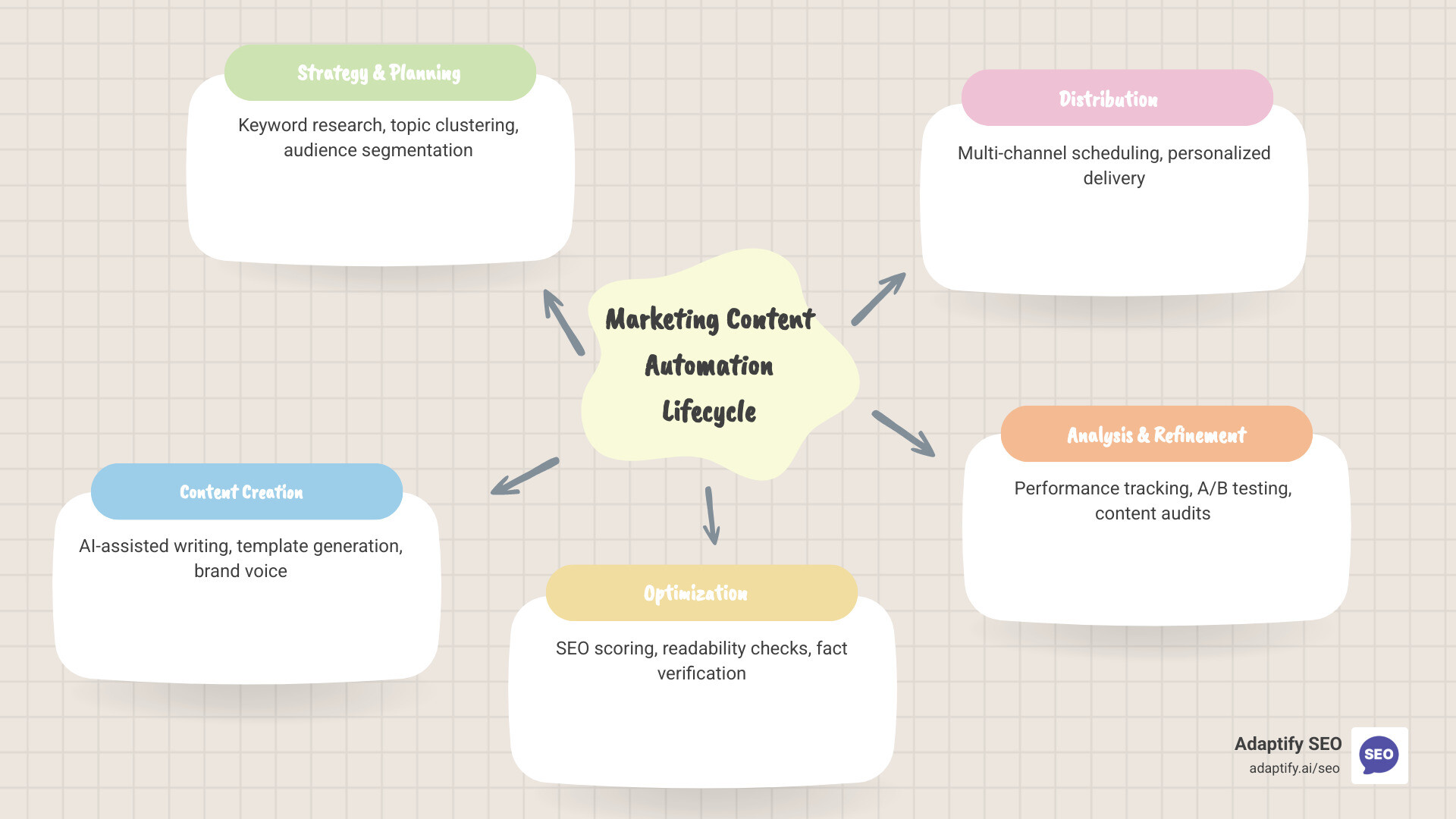
Key Components of Marketing Content Automation:
If you're running an agency in 2025, you've felt the pressure: content demand has increased by 93% from 2023, while team sizes haven't kept pace. The old manual processes are breaking as clients demand more content, faster turnarounds, and measurable results.
The agencies winning today aren't just working harder; they're working smarter through marketing content automation. They use AI to handle the repetitive tasks that consume 60-70% of a marketer's day. The data is clear: leaders who accept automation see a 29% greater revenue impact from their content and are 24% more likely to meet demands.
Implementing these systems isn't about replacing your team's creativity. It's about freeing them from grunt work to focus on high-value strategy and insight—the nuanced thinking AI can't replicate.
The shift is about survival. Businesses using marketing automation see a 451% increase in qualified leads, and 76% generate positive ROI within the first year. Your competitors are already making this transition. The question isn't if you should automate, but how quickly you can implement the right systems.
With years of experience helping SaaS and AI startups implement these systems, I've seen which automation strategies scale and which ones create more problems than they solve.

Marketing content automation uses software and AI to handle the repetitive parts of content marketing—from research and creation to distribution and analysis. It’s like having an incredibly efficient assistant who never sleeps and juggles dozens of tasks at once.
However, it's not about replacing creativity. It’s about freeing your team from grunt work to focus on what requires human intelligence: understanding client needs, crafting compelling narratives, and building relationships.
Automation benefits the entire content lifecycle. Research tools identify keyword opportunities in minutes. For creation, AI assists with drafting and maintains brand voice through templates. Distribution becomes seamless with multi-channel scheduling, and analysis shifts from manual reports to real-time, predictive insights.
Let's look at the difference between manual and automated processes:
| Feature | Manual Content Marketing | Automated Content Marketing |
|---|---|---|
| Research | Time-intensive keyword searches, competitor analysis | AI-driven keyword research, topic clustering in minutes |
| Creation | Drafts from scratch, slow iterations | AI-assisted drafting, template-based generation |
| Personalization | Limited to broad segments, time-consuming customization | Hyper-personalized content at scale, dynamic variables |
| Distribution | Manual scheduling across platforms, inconsistent timing | Multi-channel scheduling, optimal timing, consistent reach |
| Error Rate | Prone to human errors (typos, outdated info) | Reduced human error, automated proofreading |
| Scalability | Limited by team capacity, difficult to scale | Scales effortlessly with demand, handles large volumes |
| Data Analysis | Basic tracking, manual report generation, often reactive | Real-time analytics, predictive insights, proactive adjustments |
| Cost | High labor costs, potential for missed opportunities | Lower operational costs, higher ROI |
By automating just research and distribution, agencies can produce three times the content with the same team, and quality improves because people have time to think strategically.
The numbers tell a compelling story. Businesses implementing marketing content automation see a 451% increase in qualified leads. Beyond the stats, automation delivers tangible benefits:
When you're not buried in execution, you can focus on strategy. Lead nurturing becomes sophisticated and scalable with automated sequences triggered by user behavior. Audience segmentation gets granular, allowing for hyper-targeted campaigns without overwhelming your team. Consistent publishing across channels runs like clockwork, building trust and visibility. Finally, data-driven insights move from periodic reports to real-time dashboards, showing you what's working and what's not. You can find more info about our content services and how we use these insights to drive results.
Over the past two years, AI has evolved from a helpful assistant to a genuine creative partner in marketing content automation. We're now talking about machines that can write, design, and strategize alongside your team.
Generative AI has fundamentally changed the content supply chain. Tasks that once took days—research, drafting, SEO optimization, and creating audience variations—can now happen in hours. This enables personalization at scale in ways previously impossible, allowing for hundreds of customized content variations without sacrificing quality.
AI's data analysis capabilities are equally transformative, processing vast amounts of performance data to identify patterns and predict which content will resonate with specific audiences. This shift from reactive to predictive strategy is what separates thriving agencies from struggling ones. As research on AI's role in content marketing shows, we're witnessing a complete reimagining of content creation and distribution.
AI is making its biggest impact in daily workflows:
Using AI carelessly can create serious problems. It's crucial to address the ethical implications and maintain a human touch.
Human oversight is non-negotiable. Your team must fact-check every claim, verify statistics, and ensure every piece aligns with the client's brand voice. Generative AI is notorious for confidently stating falsehoods, so fact-checking AI output is critical. Finally, maintaining brand voice requires a human touch. AI can mimic style, but it can't understand the subtle nuances and emotional intelligence that define a brand. The sweet spot is using AI as a powerful collaborator, letting it handle the heavy lifting while your team focuses on strategy, creativity, and the uniquely human elements.
Implementing marketing content automation is a gradual process. Successful agencies don't try to automate everything on day one; they take deliberate, measured steps.
First, get clarity on your goals. What problem are you trying to solve? Are you drowning in repetitive tasks, missing deadlines, or struggling with personalization? Knowing your objective prevents you from investing in unused tools.
Next, understand that your data quality makes or breaks everything. Automation amplifies what you put into it—garbage in, garbage out. Before automating, clean your contact records and verify your data is current and accurate. This foundational work is crucial.
Start with simple, high-impact workflows. A welcome email sequence or social media scheduling are perfect starting points. These tasks are repetitive, deliver immediate value, and offer a safe space to learn. Once you've mastered these, you can expand to more complex automations.
Finally, map your customer journey thoroughly. Identify gaps where leads fall through the cracks and where timely content could make a difference. This map reveals exactly where automation can create a seamless, intentional customer experience. Remember to test, measure, and optimize continuously for the best results.
To avoid creating more chaos, follow these best practices for your marketing content automation rollout:
You must be able to prove that your automation is working. Your clients—and your agency—need to see results.
The good news is that 76% of companies using automation see a positive ROI within the first year. Also, track Customer Lifetime Value (CLV), as automated nurturing often increases customer retention and spending.
Let's talk about the tools that make marketing content automation work. The market is crowded, but what matters most is finding a platform that matches your specific needs and will actually be used by your team.
When evaluating a platform, focus on these core requirements:
Visual Workflow Builder: Your team should be able to easily build, see, and understand automation flows without needing to write complex code. An intuitive, visual interface is essential for adoption.
CRM Integration: The platform must connect seamlessly with your client's Customer Relationship Management (CRM) system. This creates a unified view of each customer, which is the foundation of effective personalization.
Multi-Channel Capabilities: Customers interact with brands across multiple channels like email, social media, and SMS. Your automation platform should support a cohesive experience across all these touchpoints.
Analytics and Reporting: You can't improve what you can't measure. The platform must provide accessible, actionable data that clearly shows what's working and what isn't. Don't choose a tool with weak reporting features.
Scalability and Usability: The platform should be able to grow with your clients, handling an increasing number of contacts without performance issues. Furthermore, prioritize user-friendly interfaces; a confusing tool will be ignored by your team.
The right platform depends on your clients' needs, your team's skills, and your budget. Start with a tool that matches your immediate priorities, master it, and then expand. The worst mistake is choosing a tool that is too complex for your current needs.
There's a key difference. Content automation focuses specifically on the content lifecycle: using AI to help write posts, scheduling social media updates, and analyzing how individual pieces of content perform.
General marketing automation is the broader umbrella. It includes content automation but also covers lead management (scoring and nurturing), comprehensive email campaigns, CRM activities, ad automation, and more. Think of content automation as one powerful ingredient in the larger marketing automation recipe.
No. AI is an incredible collaborator, not a replacement. It excels at handling the repetitive tasks that used to consume a creator's day, like generating first drafts or conducting keyword research. This frees your team to focus on what humans do best: strategic thinking, empathy, cultural nuance, and crafting authentic stories that build trust.
AI can't replicate the strategic insight that comes from experience. It can't fact-check itself reliably and often "hallucinates" false information. And it can't maintain a unique brand voice without human oversight. Content that lacks authenticity doesn't just underperform—it damages trust. The creators who thrive will be those who learn to use AI as a powerful assistant.
Start with something high-impact but simple to set up. An early win demonstrates value and builds momentum for your marketing content automation journey.
Good starting points include:
Pick one of these tasks, master it, and then expand your automation efforts from there.
Here's the truth: if you're still manually managing every piece of content, you're already behind. Marketing content automation isn't a futuristic concept—it's happening now, and the agencies that accept it are pulling ahead.
Automation doesn't diminish the human element of marketing; it amplifies it. When your team isn't drowning in repetitive tasks, they can focus on what truly matters: strategic thinking, creative insights, and the nuanced understanding of your clients' brands that no AI can replicate.
The 93% increase in content demand isn't slowing down. The 451% increase in qualified leads from automation isn't a fluke. The 76% of companies seeing positive ROI within a year are being strategic. They recognize that the future of marketing is a partnership between human creativity and AI-powered efficiency.
Your competitors are making this shift. The question isn't whether you should automate—it's whether you can afford not to.
For agencies ready to fully automate their SEO and content strategy, platforms like Adaptify.ai provide an end-to-end solution that handles everything from strategy formulation to content creation and PR link building. We built our platform to reduce the manual effort holding agencies back, so you can focus on the strategic work that differentiates you in the market.
The future of marketing is here. It's collaborative, intelligent, and more human than ever. Ready to transform how your agency drives results? Explore our automated SEO services and see how we can help you build that future, starting today.
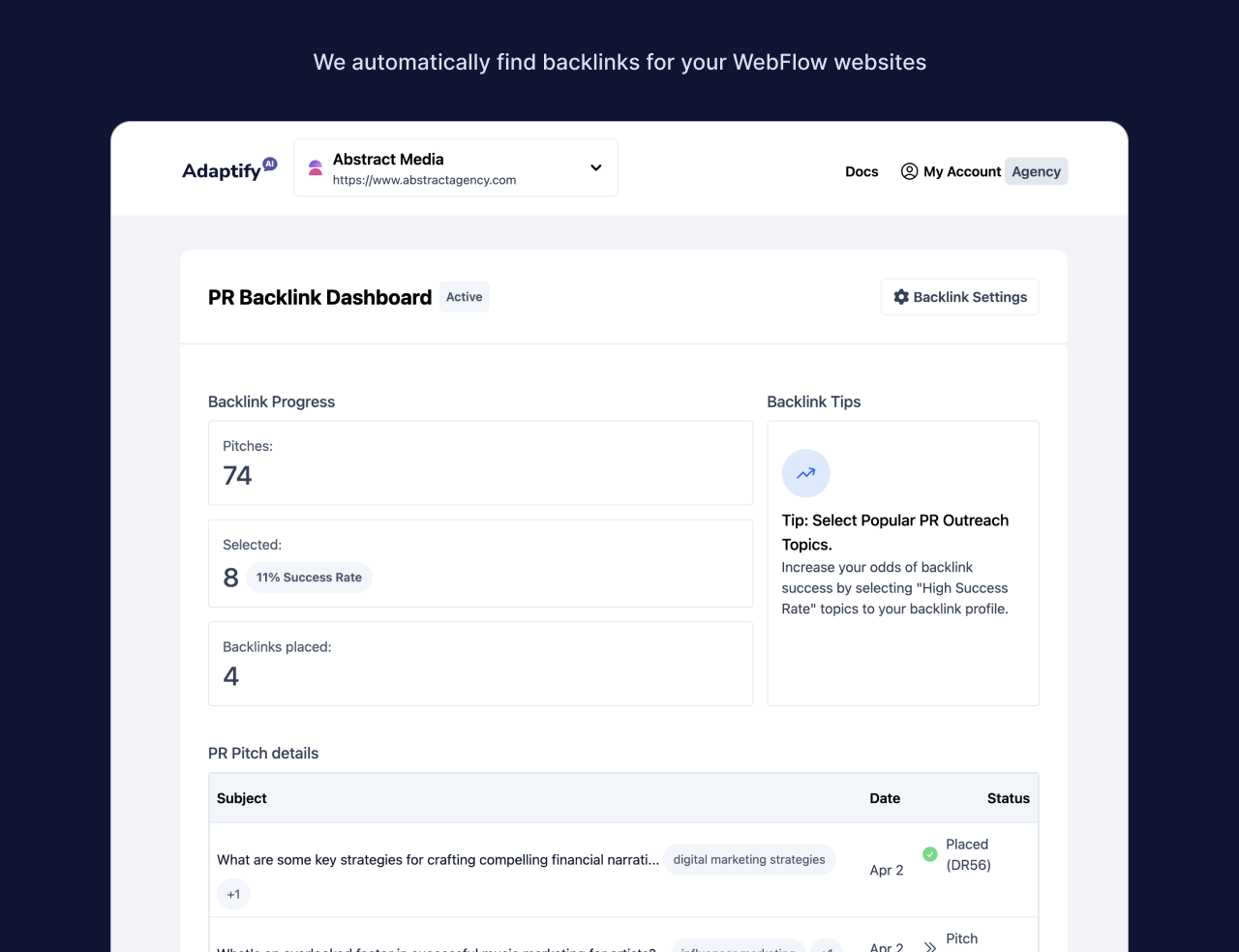
Discover how AI Powered Outreach automates link building with 3x more placements and 96% efficiency gains in 2026.

Discover how journalist outreach software replaces mass pitching with AI-powered, personalized media pitches that boost response rates and...

Master PR link building with proven strategies that earn high-authority editorial backlinks and boost your domain rating.
Join 1,000+ agencies already delivering SEO and AI visibility from a single platform without increasing their headcount.Join 1,000+ agencies already delivering SEO and AI visibility from a single platform without increasing their headcount.