Kickstart Your SEO: Building Backlinks for New Websites




When figuring out how to build backlinks for new website, the first thing you need to understand is their critical role in SEO strategy. Backlinks, or links from other websites to yours, serve as votes of confidence. They help search engines determine the relevance and authority of your site.
New websites often struggle to gain traction without a solid backlink profile. In fact, Google's algorithm weighs backlinks heavily when ranking pages. Think of backlinks as other websites vouching for your content. The more high-quality backlinks you have, the more likely Google is to view your site as authoritative.

My name is Hansjan Kamerling. I’ve worked extensively with AI startups and other tech companies, helping them skyrocket their search rankings by building strong backlink profiles. With over a decade of experience, I've seen how backlinks can lift a new website's SEO.
Let's dive into practical strategies next!
Creating linkable assets is a powerful strategy for building backlinks to your new website. These are high-quality pages that naturally attract backlinks due to their value and relevance. Here are some effective ways to create such assets:
High-quality pages are the backbone of your backlink strategy. These pages should offer unique value that other websites want to link to. Think of them as the cornerstone content of your site.
Data-driven studies are highly attractive to other websites and journalists. They provide unique insights and hard facts that others can reference.
For example, a blog post on "The 100 Most Visited Sites" earned over 9.5K backlinks from 1.1K referring domains because it provided valuable, frequently updated data.
Long-form guides are comprehensive resources on a specific topic. They cover everything a reader needs to know, making them a go-to source.
For instance, an "Ultimate Guide to Link Building" can be a valuable asset. Such guides tend to be long (often over 4,000 words) and cover multiple subtopics. This depth of content makes them highly linkable.
Infographics and visuals are another excellent way to attract backlinks. They present information in an easy-to-digest, visually appealing format.
Consider creating:
For example, LinkedIn's "The Real Face of Sales" campaign used a free photo gallery, which earned over 35 million views and numerous backlinks.

HubSpot's Email Signature Generator is a tool that offers a simple, aesthetically pleasing solution. It ranks for "signature generator" and has earned over 5,520 backlinks from 1,168 referring domains.
This success shows the power of creating useful, high-quality tools that people want to link to.
By focusing on creating these types of linkable assets, you can significantly improve your website's backlink profile and, in turn, its search engine rankings.
Guest blog posts are a powerful way to build backlinks for new websites. The main idea is simple: write a blog post for another website and include a link back to your own.
Creating high-quality content is crucial. The content must be valuable, informative, and engaging. For example, emphasize the importance of quality in guest posts. They note that providing useful information increases the chances of your post being accepted and read.
When writing your guest post, include your backlink naturally within the content. The link should fit seamlessly into the article, providing additional value to the reader. For instance, if you're writing about SEO strategies, you might link to a comprehensive guide on your website.
If you’re outsourcing the writing, vet your writers carefully. Ensure they have a good track record of producing quality content. Poorly written articles can harm your reputation and reduce the chances of your post being accepted. As highlighted by many experts, quality control is key to successful guest blogging.
Guest blogging should be mutually beneficial. The host website gets free, high-quality content, while you get a backlink. This symbiotic relationship is essential for long-term success. Forming partnerships where both parties benefit can lead to continuous opportunities for guest posts.
By focusing on these aspects, you can effectively use guest blog posts to build backlinks and improve your website's SEO.
The broken link strategy is a straightforward yet powerful method to build backlinks for new websites. When websites link to external content, those links can break if the linked page is removed or the URL changes. This results in a poor user experience and can make the site owner look unprofessional.
Replacing broken links with your content can be a win-win situation. The site owner fixes their broken link, and you get a valuable backlink. Here's how you can do it:
Identify Broken Links
Use tools like Backlink Analytics to find broken pages on websites related to your niche. For example, if you are in the personal finance space, you might check out sites like NerdWallet. Steer to the "Indexed Pages" tab and filter to show broken pages.
Analyze the Content
Look for broken pages that are relevant to your content. For instance, if you find a page about average credit card debt with many backlinks, see if you have or can create similar content.
Check Backlinks
Click on the number of backlinks to see which sites are linking to the broken page. This helps you understand the potential reach and relevance of your replacement content.
Create Replacement Content
Ensure that your content is high-quality and relevant. It should be a natural fit for the broken link you are replacing. This could be an article, guide, or any other valuable resource.
Contact Website Owners
Reach out to the owners of sites with broken links. Politely inform them about the broken link and suggest your content as a replacement. Here’s a simple template you can use:
Hi [Website Owner],

I noticed that you have a broken link on your page [URL of the page with the broken link]. The link to [Broken Page URL] seems to be down. I have a similar resource that might be useful for your readers: [Your Content URL].

Feel free to check it out and let me know if it could be a good replacement.

Thanks,
[Your Name]
As highlighted in the research, this method is effective because it addresses a problem for the website owner while providing you with a backlink. According to HubSpot, this strategy is simple yet impactful, especially when your content is a good match for the broken link.
Using the broken link strategy, you can build backlinks without creating entirely new content from scratch. This makes it one of the most efficient methods for new websites looking to establish their SEO presence.
Next, let’s explore how to find unlinked mentions to further improve your backlink strategy.
Finding unlinked mentions is one of the easiest ways to build backlinks for a new website. This method involves identifying instances where your brand is mentioned online without a link back to your site. Here’s how you can do it:
First, you need to track where your brand is being mentioned. Tools like Google Alerts can help you monitor mentions across the web. These tools notify you whenever your brand is mentioned, allowing you to act quickly.
Once you have your tools set up, you'll start receiving alerts for brand mentions. These mentions could be in blog posts, news articles, or social media posts. For instance, if someone writes a blog post praising your product but doesn’t link back to your site, you’ve found an opportunity.
Next, reach out to the website owners or authors who have mentioned your brand. A simple, polite email can go a long way. Here’s a template you can use:
Hi [Author’s Name],
I noticed you mentioned [Your Brand] in your recent article, [Article Title]. Thank you for the shout-out! I was wondering if you could add a link to our website so your readers can easily find more information about us.
Here’s the link: [Your URL]
Thanks again for the mention!
Best, [Your Name]
When you request a link, explain how it will benefit their readers by providing quick access to more detailed information. This not only improves their content but also improves the user experience.
By reclaiming unlinked mentions, you are essentially turning existing content into valuable backlinks.
Building backlinks for a new website can feel overwhelming, but breaking it down into simple steps can make the process easier. Let's look at some effective strategies: creating linkable content, guest blogging, fixing broken links, reclaiming unlinked mentions, and getting featured on resource pages.
Creating high-quality, linkable content is the cornerstone of any backlink strategy. Linkable assets are pieces of content that others find valuable enough to link to. Examples include:
Guest blogging involves writing articles for other websites in your niche. This not only helps you reach a broader audience but also earns you valuable backlinks. Here’s how to do it:
For example, writing for a reputable site like Forbes not only boosts your credibility but also provides a high-quality backlink.
The broken link strategy involves finding broken links on other websites and offering your content as a replacement. Here’s a step-by-step guide:
This method is straightforward and can be very effective in acquiring new backlinks.
Sometimes, websites mention your brand but don’t link back to you. Finding and reclaiming these unlinked mentions can be a goldmine for new websites. Here’s how:
This strategy leverages existing content, making it an efficient way to build backlinks.
Resource pages are curated lists of links that provide valuable information on a specific topic. Getting featured on these pages can give you high-quality backlinks. Here’s how:
For example, getting listed on a career planning resource page can provide a valuable backlink with minimal effort.
By focusing on these strategies, you can start building a strong backlink profile for your new website. Next, let’s explore how to get featured on resource pages to further improve your backlink strategy.
Resource pages are curated lists of links on specific topics. These pages are goldmines for backlinks because they gather the best resources in one place. Think of them as "best of" lists for the internet.
To get featured, your content needs to be relevant. If you run a cooking blog, look for resource pages about recipes, cooking tips, or kitchen gadgets. The closer your content matches the resource page’s theme, the better your chances.
Many resource pages have submission forms. These forms let you suggest your content for inclusion. Fill them out with care. Highlight why your content is valuable and how it fits the page’s theme.
For example, if you want to be featured on a career planning resource page, explain how your article offers unique insights or valuable tools for job seekers.
Analyze your competitors to find resource page opportunities. Use backlink tools like Semrush to see where your competitors are getting their backlinks. Filter the results by the word “resource” to find relevant pages.
Once you find these pages, submit your content or reach out to the site owners. A quick email can sometimes do wonders.
By getting featured on resource pages, you can earn high-quality backlinks with minimal effort. Next, let's dive into how to use Help a Reporter Out (HARO) to build even more backlinks.
If you want backlinks from media sites, connecting with journalists is a powerful strategy. One popular method is using Help a Reporter Out (HARO).
HARO connects journalists looking for sources with experts who can provide valuable insights. If a journalist uses your content, they often give you a backlink, boosting your SEO.
Sign Up: Go to the HARO website and create an account. Choose the categories relevant to your expertise.
Receive Queries: You'll get daily emails with queries from journalists. These are opportunities to share your knowledge and earn backlinks.
Be Prompt: Journalists work on tight deadlines. Respond quickly to increase your chances of being featured.
Be Relevant: Only reply to queries that match your expertise. Irrelevant responses can harm your credibility.
Be Comprehensive: Provide detailed, well-thought-out answers. Journalists appreciate thorough responses and are more likely to use your input.
By leveraging HARO, you can build backlinks from media sites and establish yourself as an expert in your field.
The skyscraper technique is a powerful way to build backlinks for new websites. The idea is simple: find content that already performs well and make it better. Here’s how you can do it:
Brian Dean from Backlinko popularized this method. He improved an existing piece on Google’s ranking factors by making it more detailed and visually appealing. The result? A significant increase in backlinks and traffic.
Creating comprehensive content means covering a topic in depth. This type of content tends to attract more backlinks because it becomes a go-to resource. Here are some tips:
For instance, a detailed guide on “how to build backlinks for new website” can cover strategies like guest blogging, broken link building, and using HARO. When your content is the most comprehensive, other sites will naturally link to it.
Visual elements can make your content more engaging and link-worthy. Use:
BuzzSumo found that infographics receive 2.3 times more shares than other content types. Unique visuals not only attract backlinks but also increase social shares, driving more traffic to your site.
Understanding what works for your competitors can give you a blueprint for your own success. Here’s how to do it:
For example, if a competitor has an outdated guide, you can create a newer, more comprehensive version. Once your improved content is live, reach out to sites linking to the old guide and suggest they link to your updated version.
By using the skyscraper technique, creating comprehensive content, incorporating unique visuals, and conducting thorough competitor research, you can significantly boost your backlink profile and improve your website’s SEO performance. Next, let’s explore how to get featured on resource pages.
Providing testimonials is a simple yet effective way to build backlinks for your new website. By sharing your positive experiences with products or services, you can gain valuable links and foster mutual benefits.
Writing reviews for products or services you use can earn you backlinks. Companies often feature customer reviews on their websites, linking back to the reviewer’s site. For instance, HubSpot’s testimonials page links back to the sites of the companies that provided the reviews.
Creating case studies about how a particular product or service helped your business can also result in backlinks. Companies love to showcase success stories. For example, Semrush has a success stories page where they feature businesses that have thrived using their tools, and these businesses gain backlinks in return.
Providing testimonials offers mutual benefits. The company gets a credible review, and you get a backlink. This win-win situation encourages more companies to link back to your site. For example, if you write a detailed post about the benefits of a tool you use, the tool’s company may share your post, giving you a backlink.
Besides backlinks, testimonials can also lead to social media shares. When companies share your testimonial on their social platforms, it increases your visibility and can drive referral traffic to your site. This added exposure can indirectly help with your SEO efforts by increasing brand awareness and social proof.
By leveraging reviews, case studies, and focusing on mutual benefits and social media shares, you can build a robust backlink profile for your new website. Up next, we’ll discuss how to get featured on resource pages.
Creating backlinks involves several strategies:
Linkable assets: Create high-quality content like data-driven studies, long-form guides, and infographics. These naturally attract backlinks. For example, a blog post on the 100 most visited sites earned over 9.5K backlinks from 1.1K domains.
Resource pages: Get listed on curated lists of links. Find resource pages that link to your competitors using tools like Semrush Backlink Analytics, and submit your site.
Broken links: Identify broken links on relevant sites and offer your content as a replacement. This helps webmasters fix their sites while giving you a backlink.
Popular content: Use the skyscraper technique to create better versions of popular content. Reach out to sites that link to the original content and suggest your improved version.
HARO: Sign up for Help a Reporter Out. Respond to journalist queries relevant to your expertise. If chosen, you get a backlink from the media.
Beginners can use several straightforward methods:
Manual additions: Start by submitting your site to business directories and local listings like the Chamber of Commerce.
Natural links: Focus on creating valuable content that others will want to share and link to naturally.
Outreach: Contact blog owners, journalists, and webmasters directly. Offer guest posts, suggest link replacements for broken links, or ask to be included in resource pages.
Testimonials: Provide testimonials for products or services you use. Companies often feature these on their websites with a backlink to your site.
For a new website, aim for 40-50 backlinks to start. Focus on:
Homepage links: These are essential for building domain authority.
Individual pages: Ensure important pages also get backlinks to rank well in search results.
Relevance: Quality over quantity. Links should come from relevant, authoritative sites.
Avoid manipulative practices: Don’t buy backlinks or engage in link schemes. Google penalizes such tactics.
By following these guidelines, you can effectively kickstart your SEO and build a strong backlink profile for your new website.
Building backlinks can be a daunting task, especially for new websites. But with the right strategies, it becomes manageable and highly rewarding. We’ve covered various methods such as creating linkable assets, guest blogging, finding broken links, and using tools like HARO to connect with journalists.
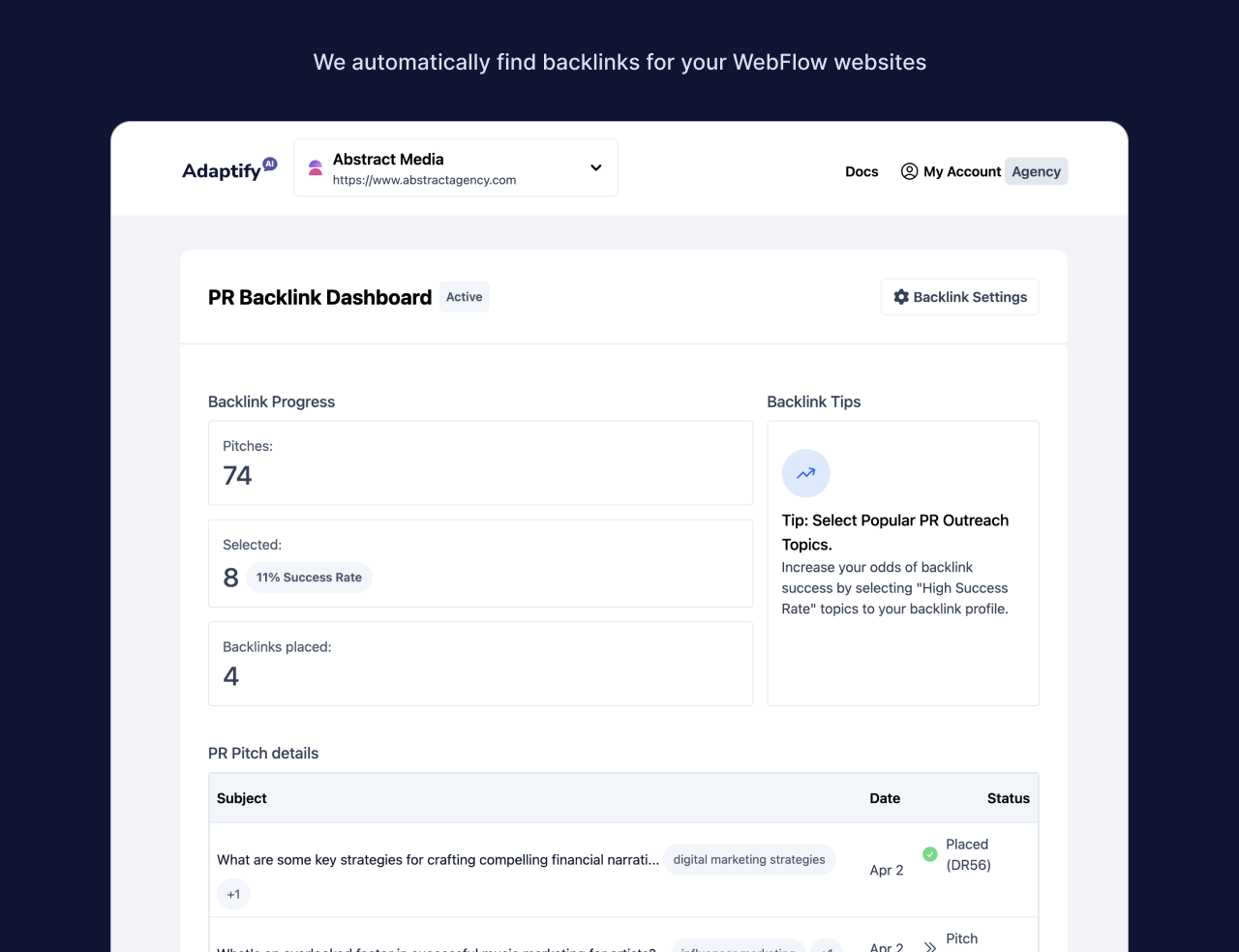
However, executing these strategies manually can be time-consuming and resource-intensive. This is where Adaptify.ai comes in.
Adaptify.ai offers automated SEO services that simplify the entire process of backlink building. Our platform provides a comprehensive solution that includes:
By leveraging Adaptify.ai, you can reduce manual effort and improve efficiency, allowing you to focus on other critical aspects of your business.
Kickstart your SEO journey with Adaptify.ai and watch your website climb the search engine rankings effortlessly.
For more details, check out our SEO services.
Discover top backlink analysis free tools like Semrush, Ahrefs & Moz. Analyze profiles, find opportunities & boost SEO without paying!

Protect your site! Learn to identify bad backlinks, remove toxic links, & disavow to prevent Google penalties and boost SEO.
Discover top SEO Backlinks Software for 2024. Compare Semrush, Ahrefs, GSA & more to boost rankings and automate link building now!
Join 1,000+ agencies already delivering SEO and AI visibility from a single platform without increasing their headcount.Join 1,000+ agencies already delivering SEO and AI visibility from a single platform without increasing their headcount.