Local SEO Demystified: How to Put Your Business on the Map

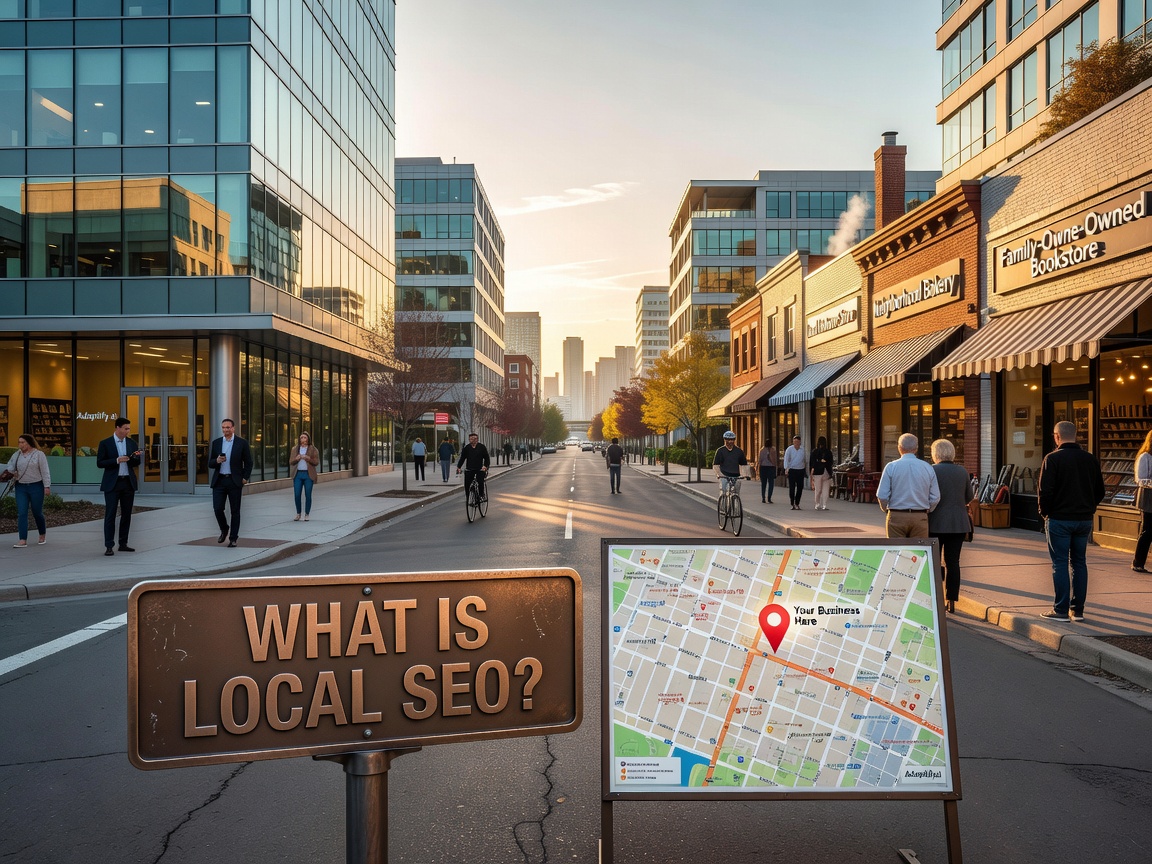


Local search optimization serves as a digital bridge between businesses and high-intent consumers in their immediate geographic vicinity. When users search for services or products with localized phrasing—such as "emergency plumber near me" or "best artisan bakery in downtown"—they are rarely conducting passive research. Instead, they demonstrate high commercial intent, frequently visiting a storefront or making direct contact within 24 hours. In fact, local searches now account for a substantial share of all mobile queries, and a significant percentage of those searches result in an offline purchase or visit within a day.
Capturing these searches requires a deep understanding of ranking factors tailored specifically for geographic discovery. Mastering these fundamentals is the focus of any solid beginner's guide to local SEO, ensuring marketing efforts generate tangible foot traffic, inbound phone calls, and localized revenue rather than untargeted website impressions. For businesses that depend on nearby customers, this visibility is not a nice-to-have; it is the difference between being found at the moment of need and being invisible to the people most likely to buy.
Traditional national or global SEO aims to rank websites for broad informational or transactional keywords regardless of user location. In contrast, local SEO is bound by geography and relies heavily on external data ecosystems, including map listings, citation networks, and localized user reviews. While national SEO often prioritizes domain authority and content depth, local SEO rewards businesses that can demonstrate relevance, proximity, and trust within a specific service area.
| Characteristic | Traditional Organic SEO | Local SEO |
|---|---|---|
| Primary Goal | Broad web traffic & national visibility | Foot traffic, phone calls, and nearby leads |
| Key Assets | Domain authority, backlinks, content depth | Google Business Profile, citations, reviews |
| SERP Features | Standard blue links, featured snippets | Google Local 3-Pack, Google Maps, Local Finder |
| Geographic Constraint | Global or country-wide | Hyperlocal (city, neighborhood, zip code) |
| Ranking Weight | Site architecture, on-page SEO, backlinks | Relevance, proximity, and prominence |
Google delivers billions of local search results every single month, making local search optimization one of the most cost-effective acquisition channels available. Businesses that put their business on the map secure prominent placements in the Local Pack, capturing roughly 44% of all clicks on local search engine result pages.
Because organic map rankings do not incur pay-per-click fees, local SEO dramatically reduces cost-per-lead compared to paid local search ads while building an enduring asset that compounds over time. A well-optimized local presence also supports every stage of the customer journey, from initial discovery and comparison shopping to final contact and in-store conversion. Over time, the businesses that consistently appear in local results build familiarity and trust, making them the default choice when nearby consumers are ready to act.
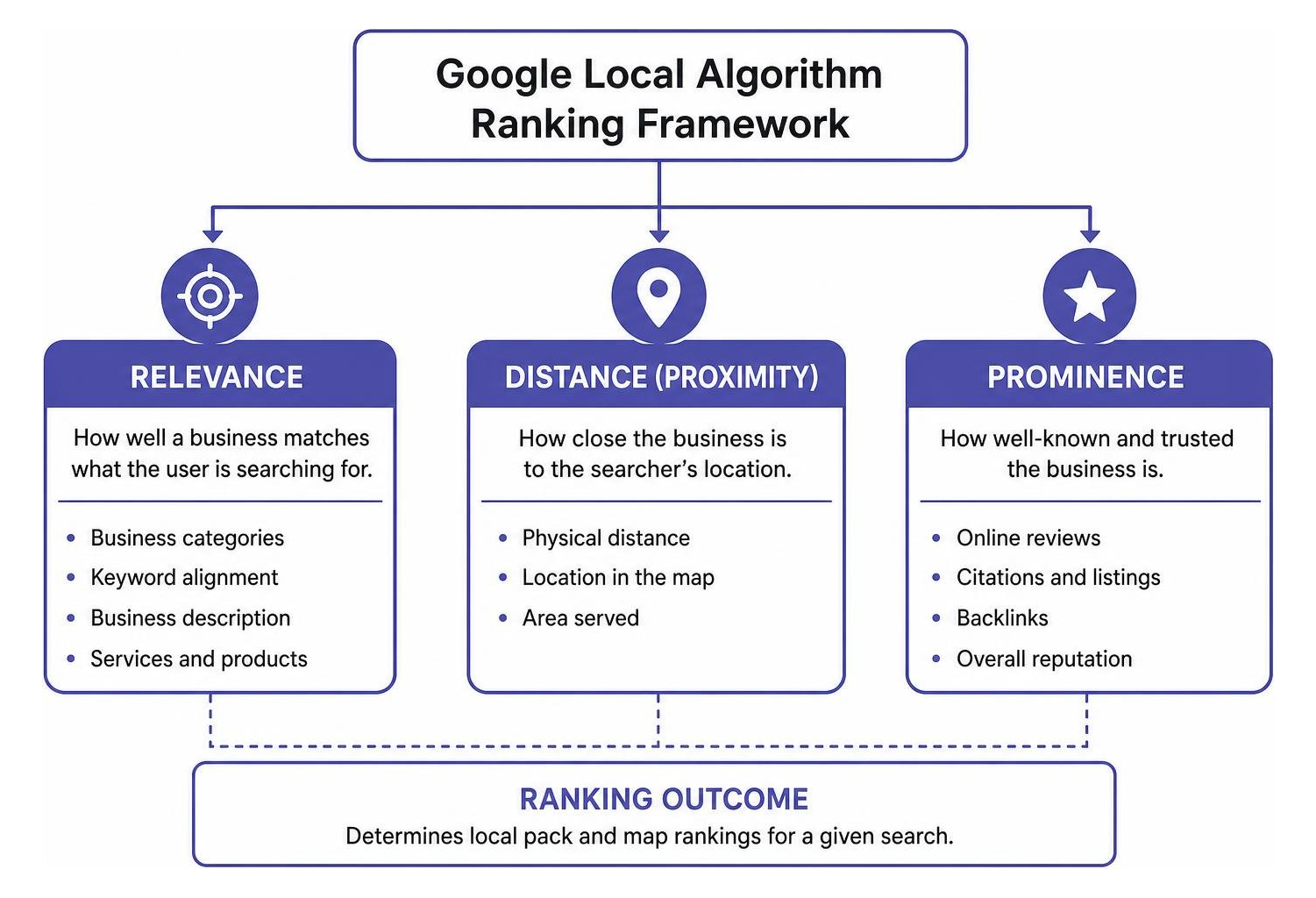
Google’s local search algorithm evaluates businesses differently than its standard web-crawling index. Rather than relying solely on page content and backlink profiles, the local algorithm operates on three distinct pillars explained in this foundational guide to local search optimization: relevance, distance (proximity), and prominence. Understanding how these pillars interact helps businesses prioritize the activities that produce the greatest local visibility gains.
Relevance measures how closely a business listing matches what a user is searching for. Search engines evaluate relevance by assessing:
When relevance signals are weak, Google may show a business for fewer queries or exclude it from competitive local results entirely. A precise category selection and detailed service information help the algorithm understand exactly what the business offers and which searches it should appear for.
Proximity evaluates the physical distance between the searcher (or the geographic location specified in the query) and the business. Because search results dynamically adapt to a user's real-time physical coordinates, no single business ranks "#1" everywhere across a metropolitan area. Google's historical Possum and Hawk algorithm updates refined how addresses and shared physical office buildings are filtered, preventing redundant or spammy listings from dominating the immediate radius.
For businesses with multiple locations or defined service areas, proximity also depends on accurate address data and clear geographic boundaries. A verified location with precise coordinates gives Google the confidence to surface the business for nearby searches, while incomplete or inconsistent address information can suppress visibility even when other signals are strong.
Prominence reflects how well-known and reputable a business is within its local community and across the broader web. Google measures prominence using several external signals:
Prominence is not built overnight. It accumulates through consistent review generation, reliable directory listings, and genuine local engagement. Businesses that invest in these signals over time become harder for competitors to displace, because Google learns to treat them as established and trustworthy options within their communities.
Executing an effective campaign requires a structured approach across multiple digital assets. Implementing this local search checklist ensures all ranking signals work in harmony. The most successful local SEO programs treat each pillar as part of a connected system rather than an isolated task, because gaps in one area can weaken the performance of the entire strategy.
A verified Google Business Profile (GBP) is the cornerstone of local visibility. Complete optimization requires:
A complete and active profile gives Google more information to match against local queries, while also giving potential customers the details they need to choose the business. Profiles that remain incomplete or inactive often lose visibility to competitors that maintain a steady stream of updates and engagement.
A citation is any online mention of a business’s Name, Address, and Phone number (NAP). Maintaining 100% NAP consistency across foundational platforms like Apple Maps, Bing Places, Yelp, and industry-specific directories is vital.
Research indicates that 62% of consumers avoid businesses with incorrect online details. Discrepancies in suite numbers, phone numbers, or naming conventions confuse search engines and erode ranking authority. Regular citation audits help identify outdated listings, duplicate entries, and inconsistent formatting before they undermine local search performance.
Customer reviews are both a direct ranking factor and a critical conversion trigger. Over 99% of modern consumers read reviews before making a purchase decision.
A proactive reputation strategy includes:
Review management also provides valuable insight into customer expectations and service gaps. Businesses that monitor review sentiment can identify recurring issues, improve operations, and turn satisfied customers into advocates who strengthen both reputation and local rankings.
A website reinforces relevance through structured on-page signals and hyperlocal optimization trends:
These on-page signals help search engines connect the website to the business’s physical presence and service area. When the website, Google Business Profile, and directory listings all tell the same story, the business sends a consistent and trustworthy signal across every local search touchpoint.
Local search has shifted toward mobile-first and artificial intelligence environments. Most local searches occur on mobile devices while users are on the move. Fast loading speeds, seamless mobile navigation, and clear click-to-call buttons directly influence both user engagement and search rankings. A slow or difficult mobile experience can erase the gains made through listing optimization, because users expect immediate access to directions, hours, and contact options when they search from a phone.
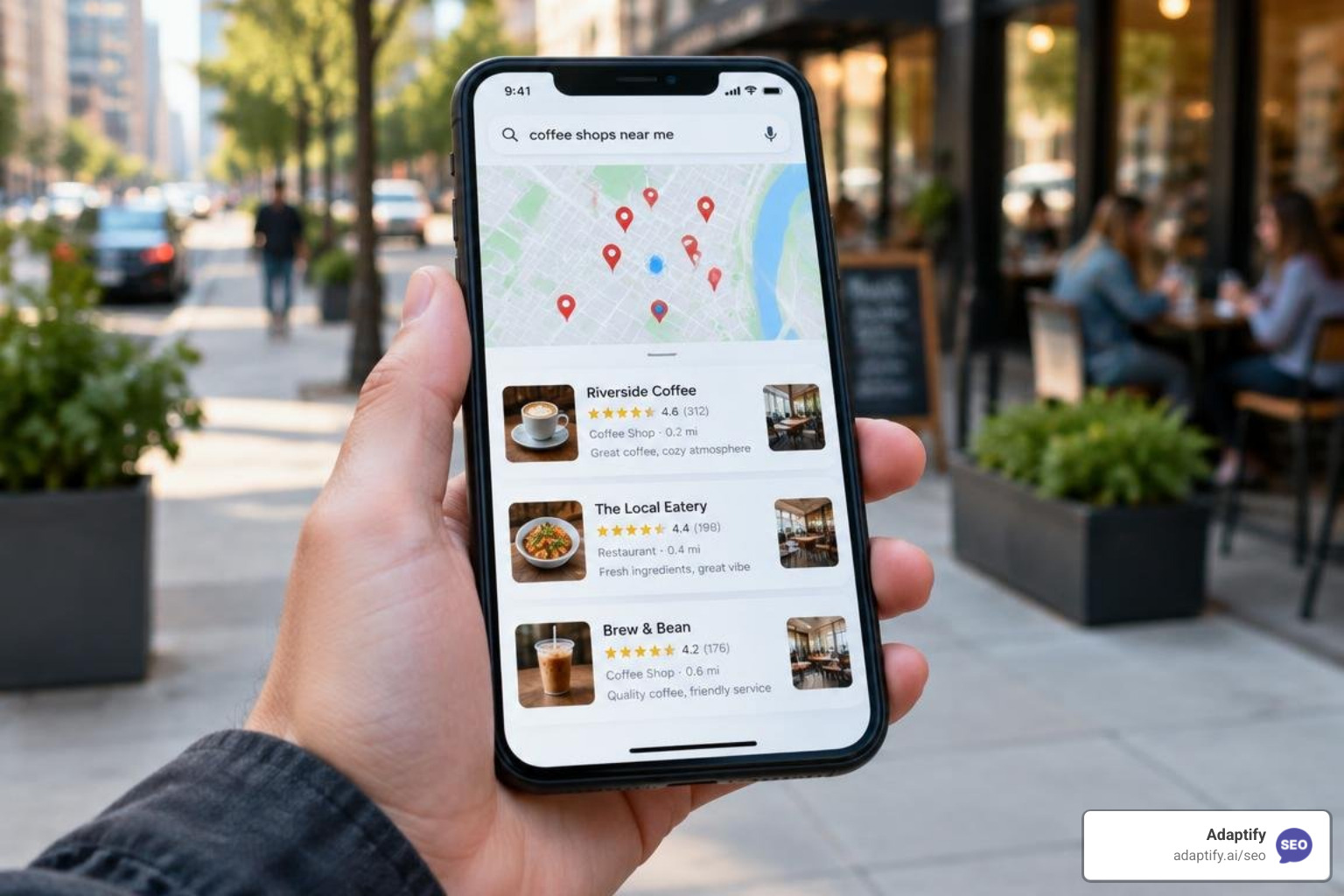
Simultaneously, Generative Engine Optimization (GEO) is changing how recommendations are served. AI engines and conversational interfaces do not simply return lists of links; they synthesize data from structured markup, Business Profiles, and sentiment within online reviews to deliver direct business recommendations.
Applying effective local SEO strategies ensures that brands maintain high visibility across both traditional Local Packs and emerging generative answer engines. As voice search and AI-assisted discovery continue to grow, businesses that provide clear, structured, and consistent local information will be best positioned to appear in the answers that shape modern purchase decisions.
Avoiding operational pitfalls is just as important as implementing best practices. Even well-intentioned local SEO efforts can fail when common mistakes undermine the signals that Google relies on for local rankings.
Each of these mistakes can reduce visibility, erode consumer trust, or trigger manual actions that remove a business from local results. Regular audits of listings, citations, and review activity help catch these issues before they become costly ranking problems.
Most businesses observe initial movement in the Local Pack within 60 to 90 days. Achieving dominant rankings across competitive geographic markets generally requires 4 to 6 months of continuous optimization, citation cleanup, and review generation. The timeline varies based on market competition, the age of the business, and the consistency of ongoing efforts, but local SEO rewards persistence with compounding visibility gains.
Yes. Businesses that travel to clients (such as mobile mechanics or plumbers) can configure a Service Area Business (SAB) profile in Google Business Profile. This hides the residential address while displaying visibility across defined service radiuses. Service-area businesses can rank effectively by defining accurate service boundaries, selecting relevant categories, and building a strong review profile that demonstrates reliability across the areas they serve.
Tracking local performance requires monitoring Google Business Profile Insights (calls, direction requests, website clicks), Google Search Console for organic landing page performance, and geo-grid tracking tools to measure Local Pack visibility across specific zip codes. Call tracking and UTM parameters add another layer of insight by connecting local rankings to actual phone calls and website conversions, helping businesses understand which optimizations drive real revenue.
Local SEO is an ongoing operational strategy rather than a one-time technical task. By optimizing business listings, maintaining consistent citation data, cultivating positive customer reviews, and publishing localized website content, businesses can secure lasting visibility in their target markets. The businesses that treat local SEO as a continuous process—rather than a one-off project—are the ones that build durable advantages in their communities.
For agencies seeking to scale local visibility across multiple clients, automated fulfillment simplifies technical workflows. Combining consistent profile management with high-authority local outreach allows brands to elevate their Google Business Profile with strategic backlinks and capture local market share efficiently. As local search continues to evolve across mobile, AI, and voice interfaces, a strong local presence remains one of the most reliable ways to connect with nearby customers at the exact moment they are ready to buy.

Going Local and Winning Big with the Best SEO Keywords - Learn about local keywords

Stop pricing anxiety and close more deals with a proven SEO package proposal framework that boosts margins and client trust.

Win bigger clients with this enterprise SEO proposal guide covering multi-stakeholder buy-in, ROI quantification, and scalable pricing mod...
Join 1,000+ agencies already delivering SEO and AI visibility from a single platform without increasing their headcount.Join 1,000+ agencies already delivering SEO and AI visibility from a single platform without increasing their headcount.