SEO and SEM: The Dynamic Duo of Digital Marketing

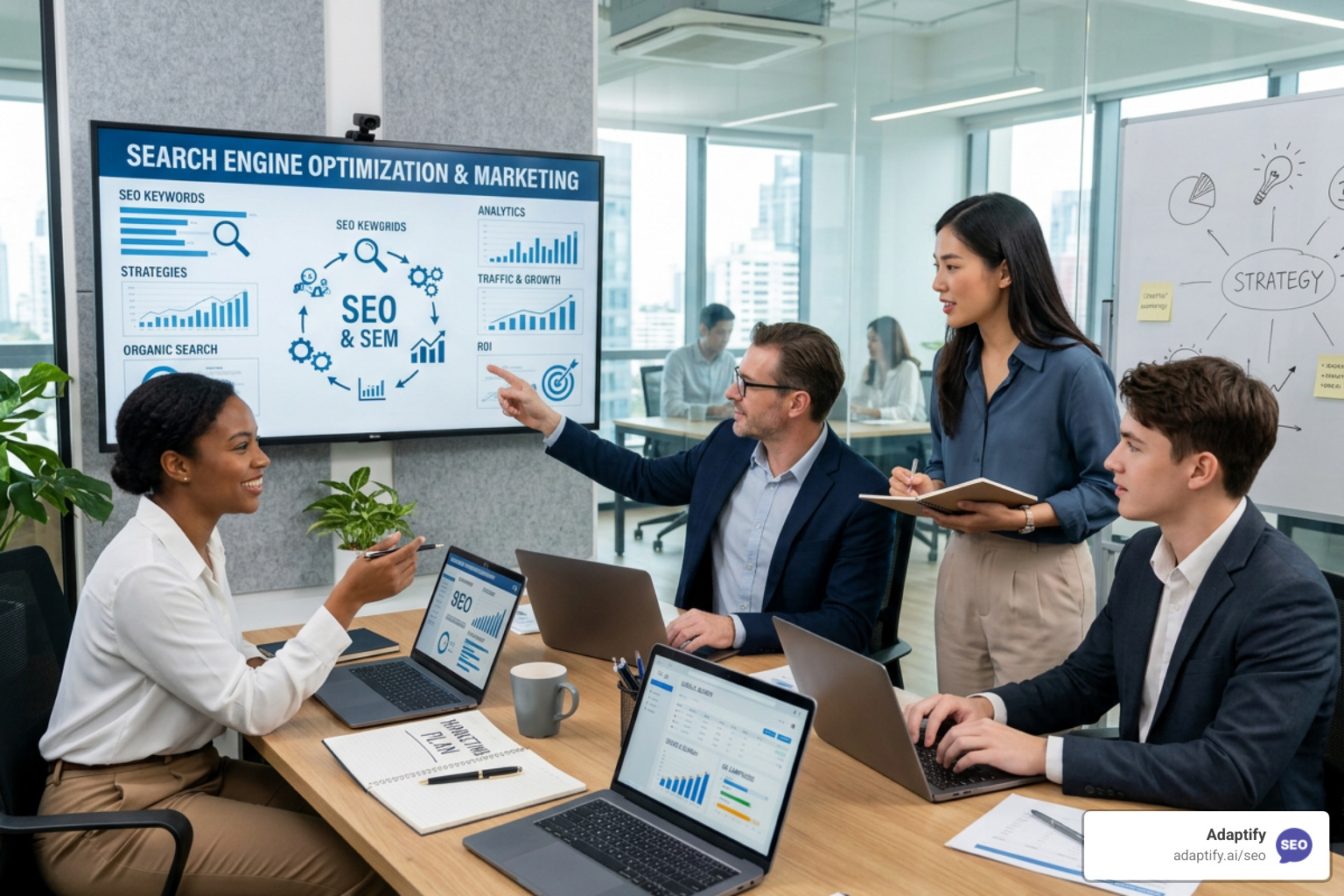

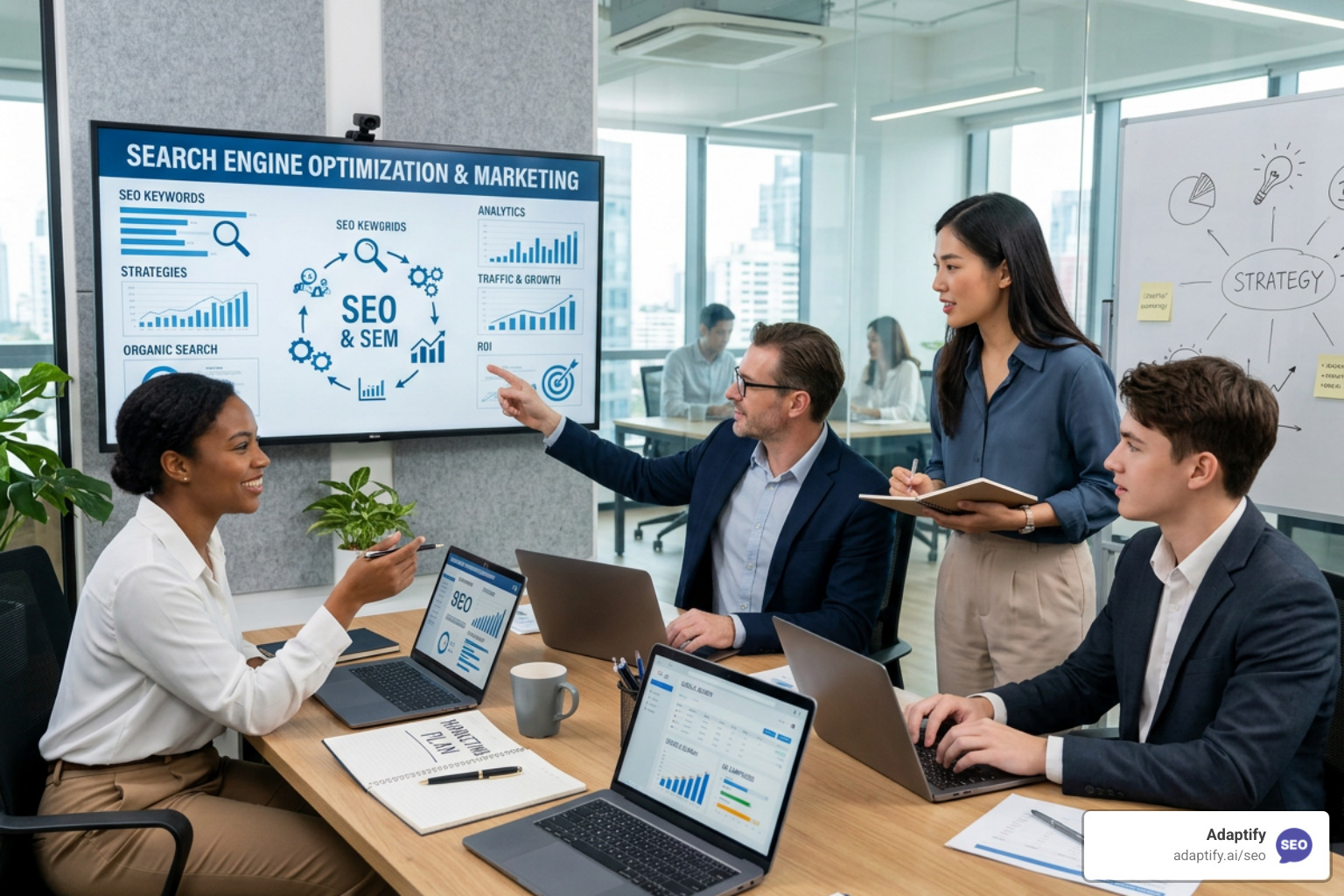
Search engine optimization and marketing is the combined practice of growing your website's visibility in search results — both through free organic rankings (SEO) and paid advertising (SEM) — to drive consistent, targeted traffic to your business.
Here is a quick breakdown of what each term means and how they work together:
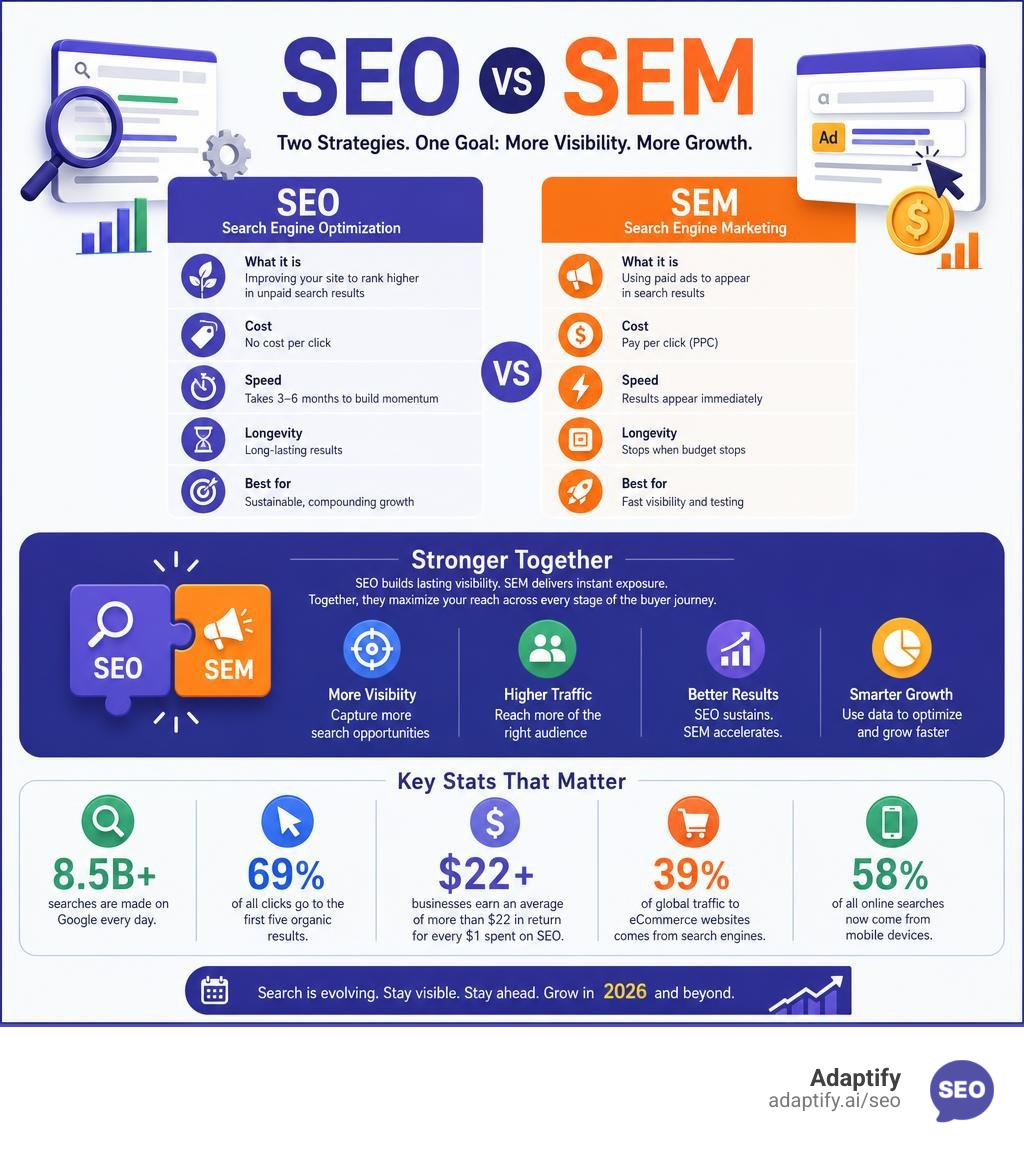
| SEO (Search Engine Optimization) | SEM (Search Engine Marketing) | |
|---|---|---|
| What it is | Improving your site to rank higher in unpaid search results | Using paid ads (like Google Ads) to appear in search results |
| Cost | No cost per click | Pay per click (PPC) |
| Speed | Takes 3–6 months to build momentum | Results appear immediately |
| Longevity | Long-lasting results | Stops when budget stops |
| Best for | Sustainable, compounding growth | Fast visibility and testing |
Together, SEO and SEM form the backbone of modern digital marketing. Google alone processes over 8.5 billion searches every day. That means billions of daily opportunities for businesses to connect with people who are actively looking for what they offer. And yet, 69% of all those clicks go to just the first five organic results. If your site is not there, your competitors are.
The stakes are real. For every dollar spent on SEO, businesses earn an average of more than $22 in return. And 39% of all global traffic to eCommerce websites comes directly from search engines. This is not a nice-to-have channel. For most businesses, it is the channel.
But here is the challenge: SEO and SEM are moving targets. AI-generated answers are reshaping how search results look. Mobile searches now make up 58% of all online queries. Algorithm updates are coming faster than ever — Google made over 5,000 changes in 2024 alone. For agency owners managing SEO at scale, keeping up while delivering consistent results for clients is genuinely hard.
This guide cuts through the noise. Whether you are building your first SEO strategy or looking to sharpen what you already do, you will find practical, clear answers here.
I'm Hansjan Kamerling, a product designer and marketing consultant who has worked across SaaS platforms, fintech startups, and digital products reaching millions of users — and search engine optimization and marketing has been central to driving growth in nearly every one of those projects. In the sections ahead, I'll walk you through everything from the fundamentals to the advanced tactics that matter most in 2026.
When I first started building web applications, I mistakenly believed that if you built a beautiful product, people would simply find it. It did not take long for reality to set in: without a deliberate strategy for search engine optimization and marketing, even the most brilliant websites remain invisible.
To succeed online, you have to understand search intent. Users do not search at random; they are looking for specific answers. Statistically, Google searches break down into very distinct categories of intent:
By aligning your content with these intents, you ensure that you are not just driving empty traffic, but attracting users who are highly likely to convert. This alignment is what drives incredible conversion rates and long-term ROI. If you want to dive deeper into how this works, check out my guide on Unlock Your Potential: The Benefits of a Winning SEO Strategy.
Let us break down the first half of this dynamic duo. Search Engine Optimization (SEO) is the art and science of preparing your website to appeal to search engine bots so that they index your pages and present them as the best possible answer to a user's query.
Search engines use automated programs called crawlers to continuously scour the web, reading text, following links, and analyzing code. When your site is optimized, you make it easy for these bots to understand what your business is about. The ultimate goal of SEO is to build sustained, high-quality organic visibility without paying for every single click. You can learn more about these core principles in the What Is SEO? Search Engine Optimization Best Practices - Moz resource.
While SEO focuses on earning organic real estate, Search Engine Marketing (SEM) leverages paid search to buy immediate placement. In the industry, SEM is often used interchangeably with Pay-Per-Click (PPC) advertising.
The differences between the two come down to speed, cost, and longevity. With SEM, your ads go live instantly, and you pay Google every time someone clicks on them. In fact, Google continues to dominate this space, projected to garner over 70% of US traditional search ad spending in 2026. However, the moment your budget runs out, your traffic drops to zero.
SEO, on the other hand, requires an upfront investment of time and resources, but its benefits compound. Once you rank organically, those clicks are free, and they keep coming day after day. For a complete look at how these channels compare, Shopify offers great insights in their guide on SEO Marketing: Types, Tactics, and Metrics (2026) - Shopify.
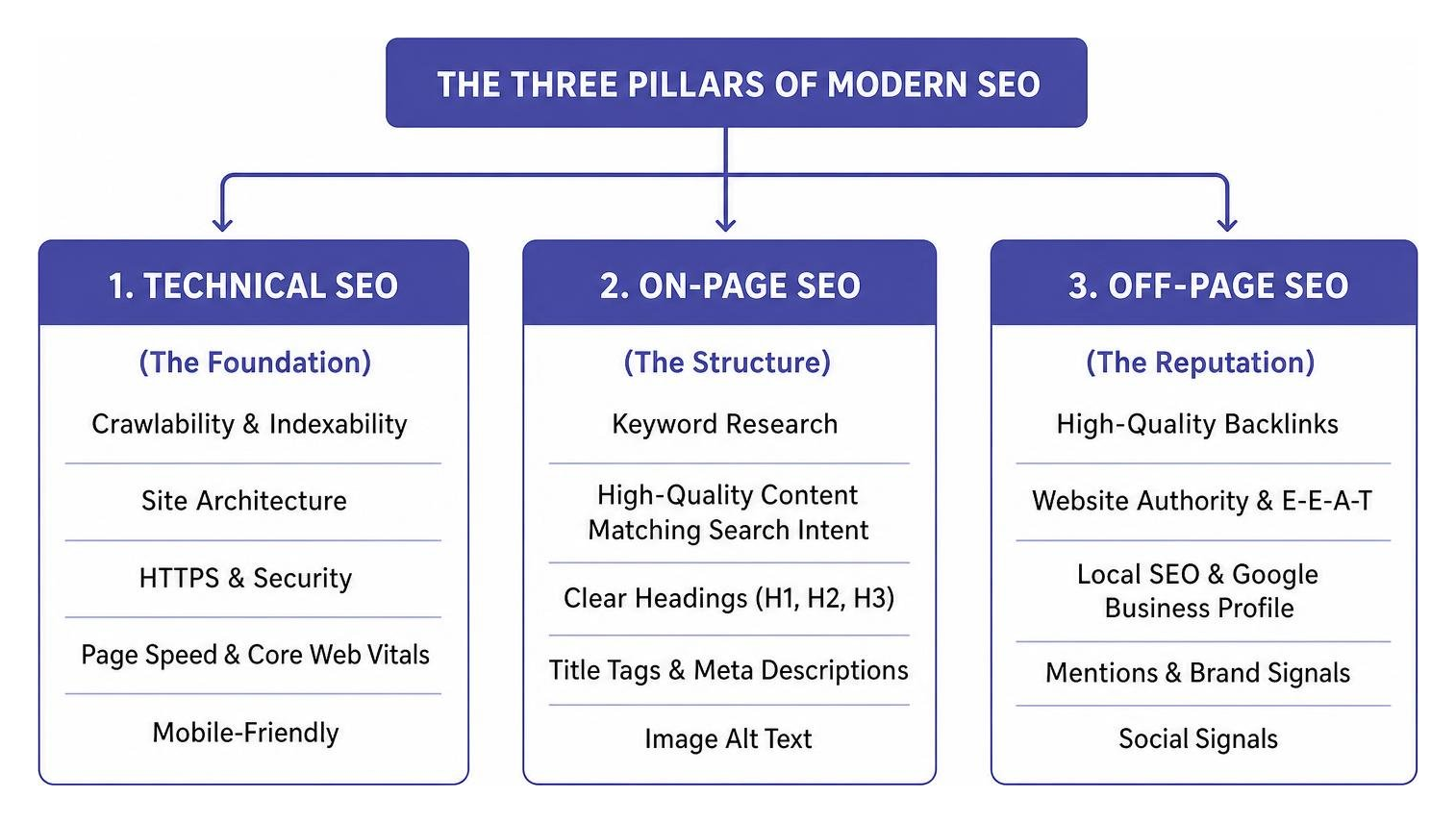
To build a website that ranks consistently, you must balance the three core pillars of SEO. I like to think of these as the foundation, the structure, and the reputation of your website.
Understanding how search engines operate helps demystify why certain pages rank while others do not. The process happens in three main steps:
If you are new to this process, Moz has an excellent, comprehensive roadmap in their Beginner's Guide to SEO (Search Engine Optimization) - Moz.
As we navigate 2026, the search landscape is experiencing its most significant shift in decades. AI Overviews and Generative Engine Optimization (GEO) are changing how users consume information. Rather than presenting a list of blue links, search engines increasingly synthesize direct, AI-generated answers.
Interestingly, traditional SEO remains the foundation for AI search visibility. Data shows that 97% of AI Overviews cite at least one source from the top 20 organic search results, and 73% of cited websites rank in the top 10. To be cited by AI engines like Gemini or Perplexity, your content must be structured, highly authoritative, and direct.
Additionally, mobile search continues to dominate, with the mobile SEO market expected to grow at a 10.0% CAGR by 2030. Visual and voice search are also on the rise, meaning businesses must optimize their images with descriptive alt text and write in a natural, conversational tone.
For modern agencies, keeping up with these shifts manually is nearly impossible. That is why automated workflows are becoming the industry standard. To see how automation can keep you ahead of the curve, read my articles on AI-Powered SEO: Automate Your Way to the Top and The Future is Now: Mastering Automated SEO for Better Results.
In the quest for higher rankings, some marketers are tempted to take shortcuts. In SEO, these techniques are categorized into "White Hat" (ethical, user-focused practices) and "Black Hat" (manipulative, search-engine-gaming tactics).
I strongly advise staying far away from black hat techniques. While they might offer a temporary boost, search engines are incredibly smart and will penalize or completely ban websites that violate their guidelines.
Here is a list of black hat techniques to avoid at all costs:
Focusing on sustainable, white hat growth ensures your website remains safe from algorithm penalties and continues to drive organic traffic for years to come.
Mastering search engine optimization and marketing is no longer just about understanding keywords; it is about building a comprehensive, multi-channel presence that satisfies both human searchers and search engine algorithms. However, executing this strategy at scale—especially for agencies managing dozens of clients—requires immense time and effort.
This is where Adaptify comes in. Adaptify.ai offers an all-in-one automated SEO solution designed specifically to streamline agency workflows. By automating complex processes like keyword strategy, AI-driven content creation, and PR link building, Adaptify allows your team to scale operations, reduce manual effort, and deliver consistent, high-impact results for your clients.

Ready to scale your SEO operations without the manual headache? Explore our features and tools or book a live demo. If you are ready to transform your agency's workflow today, check out our pricing plans or sign up for a free trial to start your automated SEO journey.

Discover health insurance for engineers: group rates via ASCE, IEEE, portable plans, small firm options, and pro tips to save.

Discover how medical SEO specialists elevate your practice with targeted strategies for local search, E-E-A-T, & patient growth.

Boost your real estate leads with Local SEO for real estate. Dominate Google Maps, outrank portals & master GBP in 2026!
Join 1,000+ agencies already delivering SEO and AI visibility from a single platform without increasing their headcount.Join 1,000+ agencies already delivering SEO and AI visibility from a single platform without increasing their headcount.