Tech-First SEO: Best Agencies with Seamless Software Integration




SEO agencies technology integration has moved from a nice-to-have into the core of how modern agencies compete and deliver results. If your agency is still running audits, keyword research, and reporting by hand, you're burning hours that could be spent on strategy — and falling behind firms that have automated those workflows.
Here's a quick breakdown of what tech-integrated SEO agencies actually do differently:
| What They Integrate | Why It Matters |
|---|---|
| AI and machine learning tools | Faster audits, smarter keyword clustering, content gap analysis at scale |
| Generative Engine Optimization (GEO) | Visibility in ChatGPT, Perplexity, Google AI Overviews — not just traditional search |
| Crawl and indexing platforms | Catch JavaScript rendering failures, index bloat, and architecture issues early |
| Schema and structured data tools | Help search engines and LLMs understand your content as entities |
| Automated reporting pipelines | Weekly insights from Google Search Console and GA4 without manual exports |
| CRM and pipeline attribution | Connect organic traffic to actual revenue, demos, and closed-won deals |
| Agentic workflows | Autonomous research, content proposals, and PR tracking with human review |
The shift is significant. Agencies that once delivered a monthly PDF report are now running agentic systems that pull live data, flag regressions, and draft prioritized fix lists — all before a strategist opens their laptop. One case study from the research shows an agency building a weekly automated reporting pipeline that replaced sporadic manual snapshots with no historical context, while another saved 20 hours in a single week by using an AI agent to handle keyword research and content strategy.
The pressure to adopt this stack isn't just internal. Search itself has changed. Google's AI Overviews, ChatGPT, and Perplexity are now answering queries that used to drive clicks. Agencies that can't optimize for those surfaces are leaving their clients invisible in a growing share of searches.
This article is your guide to the agencies and platforms that have built technology into the core of their SEO delivery — not bolted it on after the fact.
I'm Hansjan Kamerling, product designer and marketing consultant at Adaptify AI, with experience scaling AI-powered platforms and designing data-driven products used by millions — work that gives me a grounded view of how SEO agencies technology integration translates from theory into real workflow change. in the sections below, I'll walk you through the tools, strategies, and agencies leading this shift so you can make a smart decision about where to focus your own technology investments.
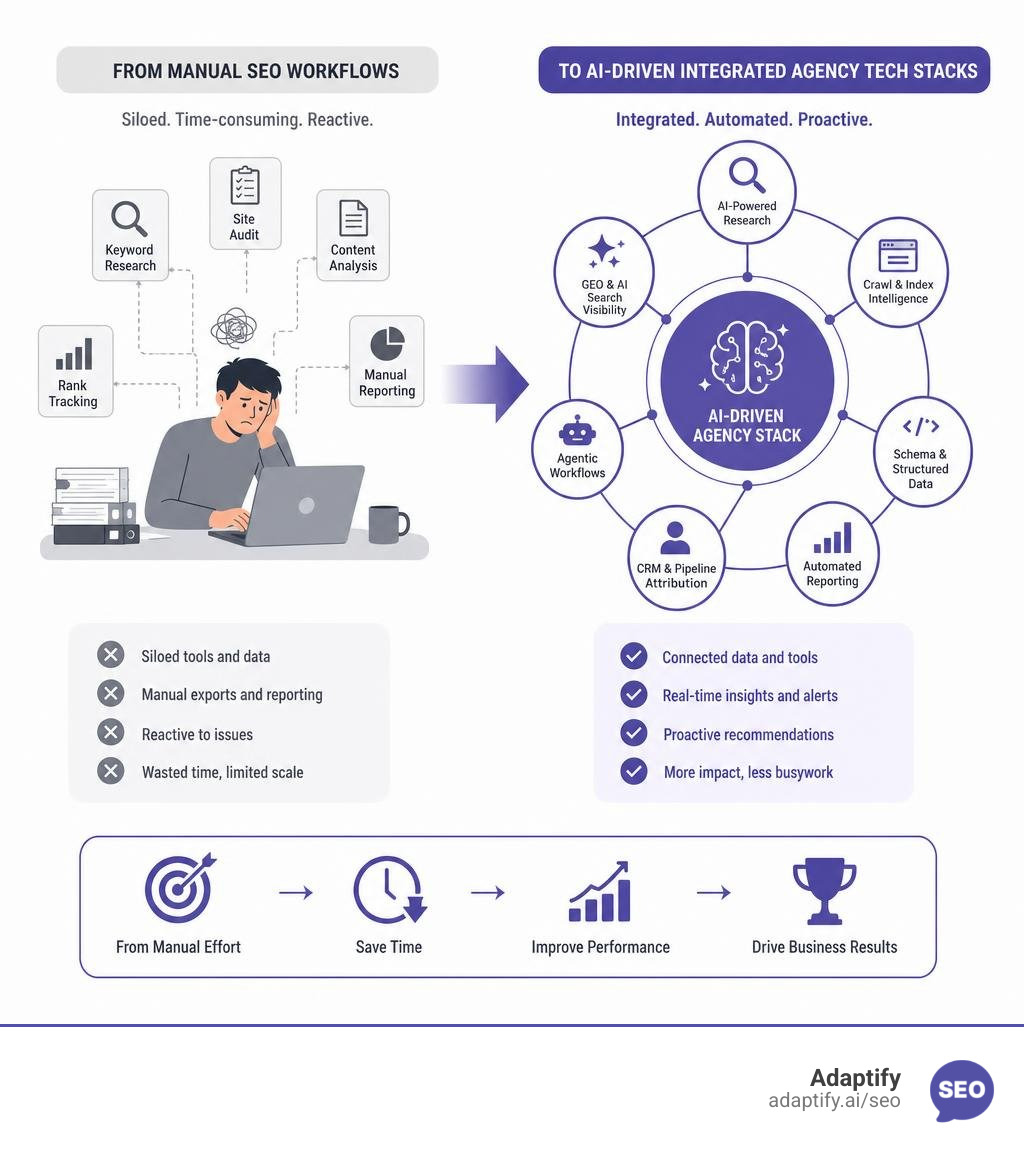
When we look at high-performing campaigns in 2026, the differentiator is rarely "more content." It is almost always better data flow. Historically, SEO lived in a silo. An agency would run an audit, hand over a spreadsheet of broken links, and hope the client’s developer did something with it.
Today, strategic integration means connecting SEO tools directly to the client’s tech stack. By bridging the gap between search platforms, content management systems, and customer relationship management (CRM) systems, agencies can build a direct data pipeline.
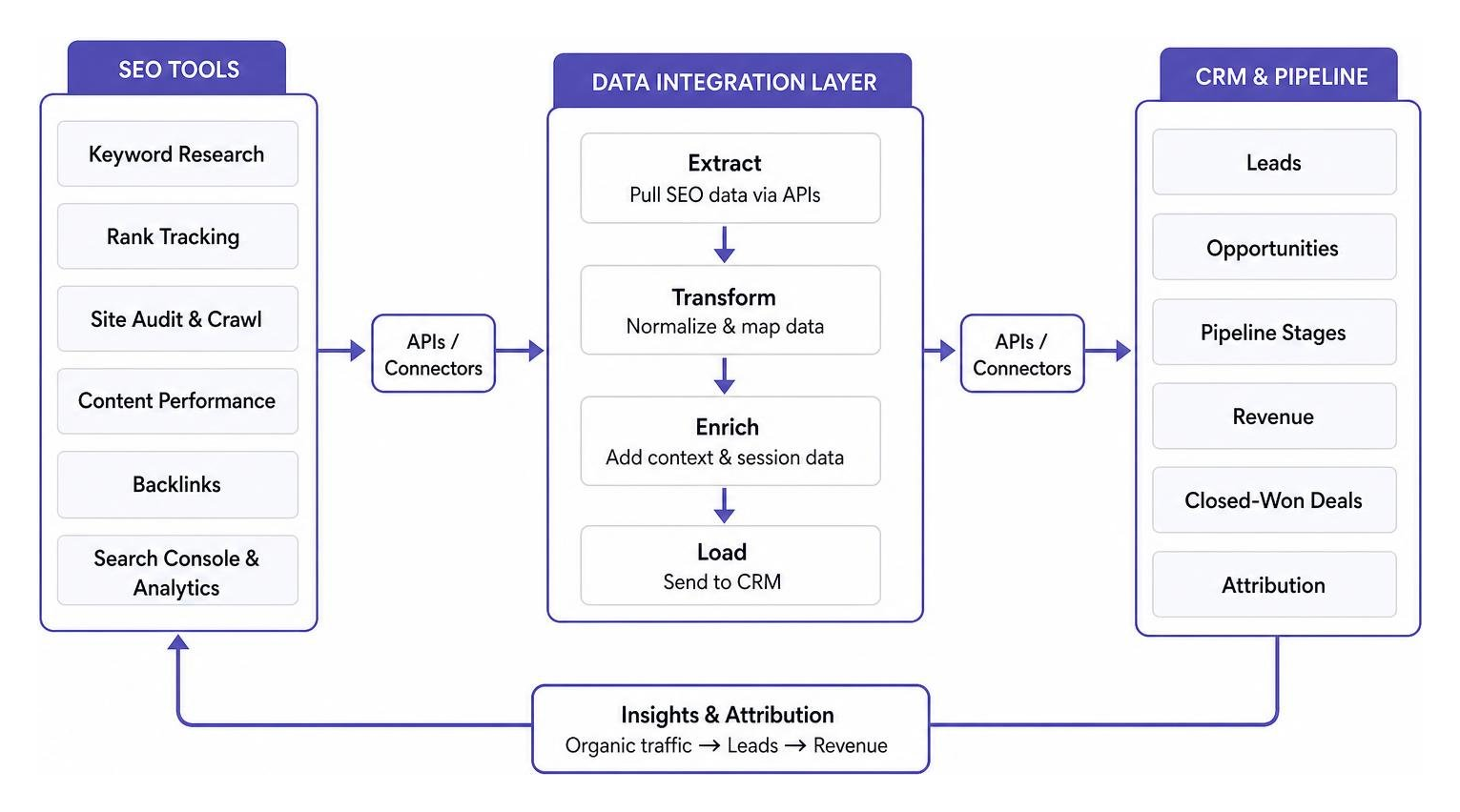
This direct API integration ensures that keyword strategy is driven by actual pipeline value rather than vanity search volume. Instead of chasing high-volume, low-intent keywords, tech-first agencies track organic touchpoints directly to trials, demos, and closed-won deals. If your agency isn't looking at your CRM data, they are essentially flying blind.
The traditional search engine results page (SERP) is no longer the only game in town. With the rise of Google's AI Overviews, ChatGPT, Gemini, Claude, and Perplexity, users are increasingly getting direct answers without clicking through to a website.
To adapt, forward-thinking agencies are shifting from standard search optimization to Generative Engine Optimization (GEO). This requires a completely different technical approach. To be cited by large language models, your site needs absolute entity clarity. This means structuring your content so that machines can easily parse the relationships between your brand, your products, and the problems you solve.
Securing these citations relies heavily on advanced schema markup, clean content architecture, and authoritative digital PR mentions. Practical citation guides, including Adsy's breakdown of how to get cited by AI, reinforce the same point: AI visibility depends on making your brand easy for answer engines to understand, trust, and reference. If you want to understand how this shifts the playing field, check out my deep dive on The AI Advantage: Adapting Your SEO for the Generative Era. To track your visibility across these new AI surfaces, agencies are turning to specialized software platforms. You can find the leading tools in this space in our breakdown of The Best AI-Powered Geo SEO Platforms for 2026.
To keep complex websites ranking, agencies rely on a highly specialized toolkit. It goes far beyond basic rank trackers. Modern technical SEO requires continuous monitoring of Core Web Vitals, automated crawl analysis to catch rendering errors (especially on JavaScript-heavy frameworks), and specialized schema builders.
For international brands, the complexity multiplies. Managing multilingual SEO and global site architectures requires tools that can monitor hreflang tags, track localized search trends, and audit indexation across dozens of regional subdomains.
One of the most exciting developments in 2026 is the adoption of the Model Context Protocol (MCP). MCP is an open standard that allows AI assistants to securely connect to external data sources. For example, tools like GenieSeo — Google Search Console + GA4 MCP for Claude & Cursor allow agencies to plug live Google Search Console and Google Analytics 4 data directly into AI clients like Claude or Cursor. Instead of manually exporting CSV files, an strategist can simply ask their AI assistant to "find all high-impression pages with declining click-through rates over the last 90 days" and get an instant, data-backed analysis.
For a complete look at the software stack driving modern visibility, see The Ultimate Guide to AI Visibility Tools for the 2025 US Market.
Automation in 2026 is about more than scheduling social media posts; it is about building robust, multi-stage agentic workflows.
Take site migrations, for example. Historically, migrating a site of 10,000+ pages was a recipe for a temporary traffic disaster. Today, agencies use automated staging crawlers that map old URLs to new ones, test redirect rules in real-time, and flag canonical discrepancies before the site goes live.
In backlink building, automation handles the heavy lifting of prospect research and digital PR tracking, allowing PR specialists to focus entirely on building real relationships with journalists.
Even content optimization has been revolutionized by "LLM-as-judge" frameworks. Before a piece of content is pushed to a staging environment, an automated agent audits the text against the brand's style guide, checks for topical completeness, and suggests internal linking opportunities. Once approved by a human editor, the changes can be automatically deployed via GitHub PRs.
To see how these workflows can scale your operations, read our guide on AI-Powered SEO: Automate Your Way to the Top and discover how to Future-Proof Your Agency: A Guide to AI-Powered SEO.
While automation provides incredible speed, fully autonomous SEO is a major risk. Search engines are highly sensitive to low-quality, mass-produced AI content. To succeed in highly competitive niches like eCommerce, healthcare, and SaaS, agencies must balance technology with human expertise.
We call this "human-in-the-loop" automation. AI agents do the mechanical work — pulling data, clustering keywords, and drafting initial outlines — while human strategists bring the industry context, brand voice, and real-world experience. This is especially critical for meeting Google's E-E-A-T (Experience, Expertise, Authoritativeness, Trustworthiness) guidelines.
In healthcare, for instance, an AI can draft a medical article, but a qualified practitioner must review it for clinical accuracy. In SaaS, an AI can find search volume, but it takes a seasoned marketer to understand the nuances of a product-led growth funnel. For more on how to strike this balance, read about The Brains Behind the Bots: Why You Need an AI SEO Consultant and learn Beyond the Buzz: How to Formulate a Winning AI Strategy.
A challenge in SEO agencies technology integration is getting the client's development team to actually implement technical recommendations. Developers are busy, and SEO fixes often sit at the bottom of their backlog.
Tech-first agencies solve this by formatting their deliverables as implementation-ready developer tickets. Instead of sending a vague PDF saying "improve site speed," they deliver a Jira or GitHub ticket specifying the exact files, CSS rules, or server configurations that need modification, complete with the expected business impact.
Additionally, agencies must manage technical limitations like API rate limits, ensure strict data privacy compliance when handling CRM data, and build accurate multi-touch attribution models. To understand how to tie these technical efforts directly to business growth, explore The New Frontier: Integrating AI and Geo for Business Growth.
If you are looking to partner with a team that puts technology first, it helps to look at how different agencies allocate their resources.

While many traditional digital marketing agencies spread themselves thin across social media, PPC, and design, specialized firms dedicate a significant portion of their core expertise to technical SEO and software integration.
| Agency / Platform | Technical SEO Expertise Allocation | Primary Technology Focus |
|---|---|---|
| ROAST | 35% | Advanced technical architecture and data analysis |
| Disruptive Advertising | 30% | CRM integration and pipeline attribution |
| Black Propeller | 25% | Core Web Vitals and site speed engineering |
| Passion Digital | 20% | International and complex site structures |
| SimpleTiger LLC | 15% | SaaS-specific product and search integrations |
| LinkDoctor | 15% | Automated backlink and PR outreach pipelines |
| SmartSites | 10% | eCommerce platform optimization |
| Intero Digital | 10% | Enterprise-level multi-channel data flow |
| Adaptify.ai | Platform-Driven | Fully automated AI SEO, PR link building, and white-label reporting |
For agencies looking to scale their SEO offerings without hiring an army of developers and analysts, the answer often lies in software platforms rather than traditional consulting firms.
This is where Adaptify.ai fits in. We offer a comprehensive, automated SEO solution designed specifically for agencies. Instead of managing dozens of disconnected tools, Adaptify streamlines your entire workflow:
By integrating these core workflows into a single, intuitive platform, we help agencies reduce manual overhead, improve turnaround times, and deliver consistent, measurable results for their clients.
To see how tech-first automation can transform your business, read The Future Is Now For SEO Agencies: AI Insights You Can't Ignore and explore our advanced guide on Beyond the Basics: Advanced AI Strategies for SEO Success.
Ready to see it in action? Book a Demo with Adaptify today, or explore our pricing plans to find the perfect fit for your agency. You can also sign up for a trial and start optimizing your workflows in minutes.

Learn how AI link building outreach scales campaigns with automation, personalization, and tools to boost backlinks and ROI.
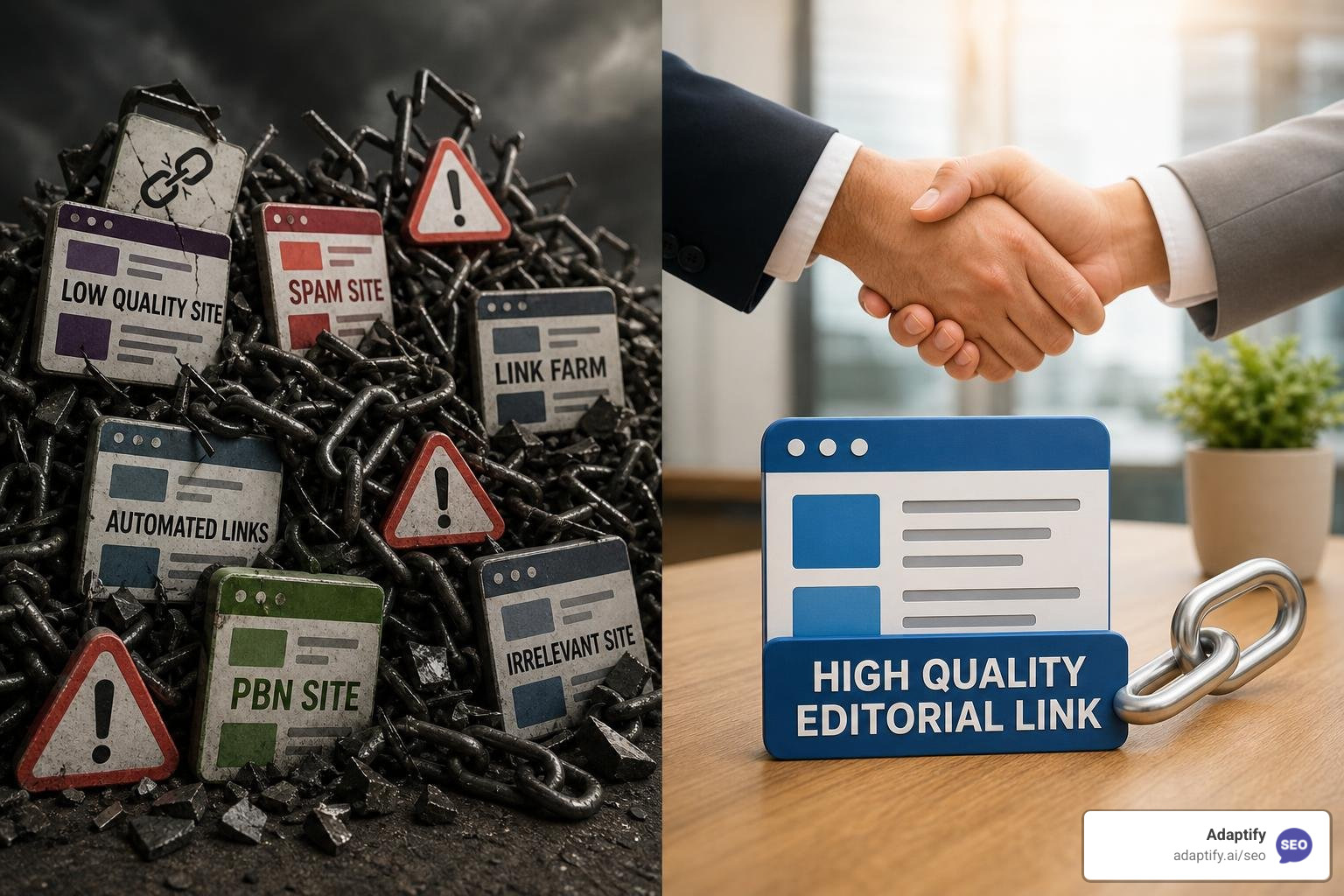
Discover the best AI for link building in 2026, from prospect discovery to digital PR, with safe human-in-the-loop workflows.
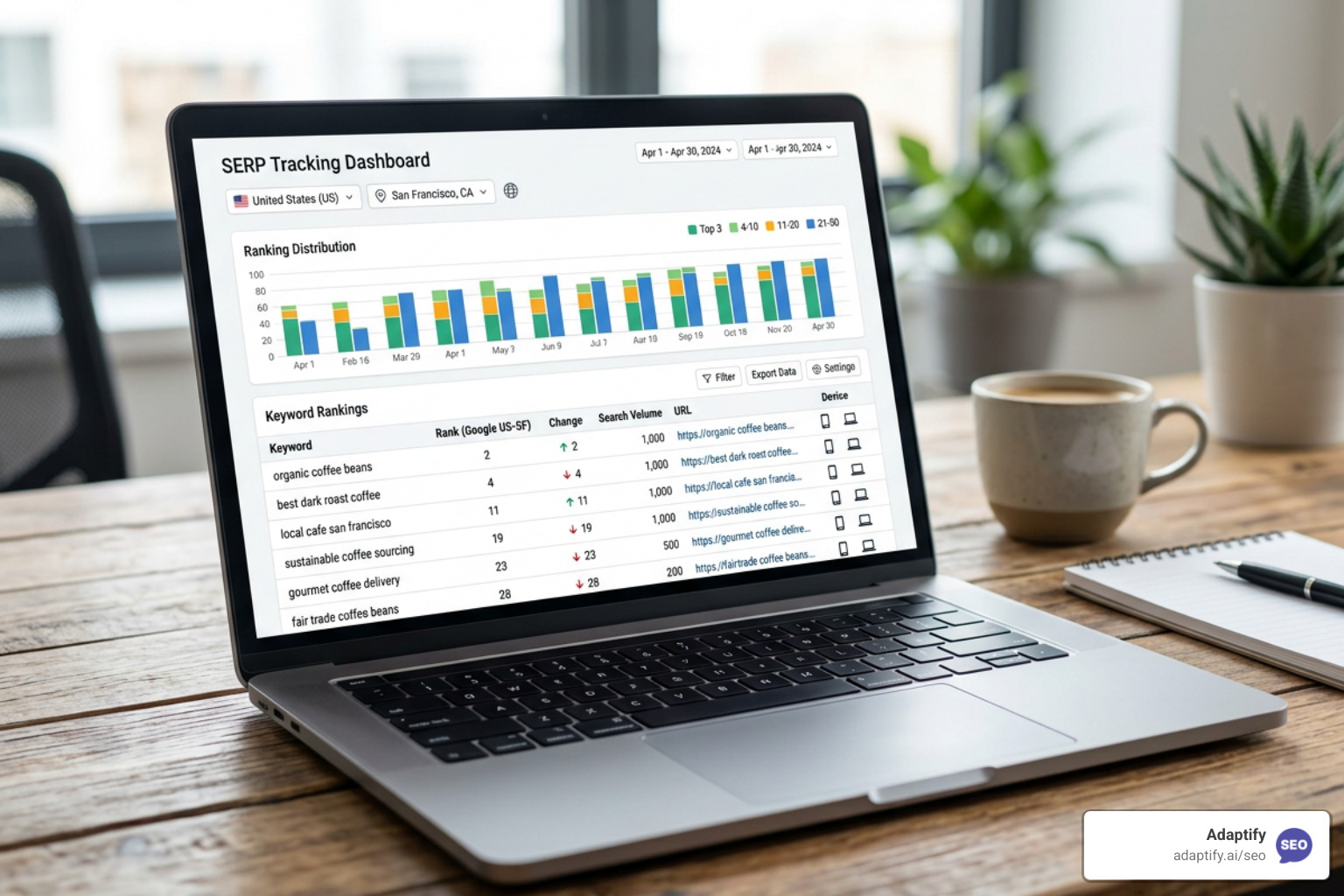
Stop guessing rankings—use a serps tracking tool to monitor SERP features and AI visibility for real SEO growth.
Join 1,000+ agencies already delivering SEO and AI visibility from a single platform without increasing their headcount.Join 1,000+ agencies already delivering SEO and AI visibility from a single platform without increasing their headcount.