Scaling Your Digital Agency Through Expert Content Strategies




Agency content creation is the process of outsourcing your content strategy, production, and optimization to a specialized team - so your business can grow without adding headcount or burning out your internal staff.
Here's what you need to know at a glance:
| What It Is | What It Solves | What It Delivers |
|---|---|---|
| Outsourced content strategy + production | Slow, inconsistent, resource-heavy content | Consistent, SEO-optimized content at scale |
| Blend of human expertise + AI tools | Lack of subject matter depth | Higher rankings, more leads, lower cost |
| Full-service or niche-specialized teams | Fragmented tools and workflows | Measurable ROI tied to business growth |
Content marketing costs 62% less than traditional marketing and generates roughly 3x as many leads, according to DemandMetric. Yet most agency owners still treat content as an afterthought - something squeezed in between client deliverables rather than a core growth engine.
There is a real difference between just producing content and using content as a direct business growth channel. The agencies that scale in 2026 are the ones that treat content as a system - not a task list.
Whether you're trying to deliver better results for clients, reduce the manual grind of content production, or build a repeatable process that doesn't depend on a single star writer, this guide is for you.
I'm Hansjan Kamerling, a product designer and marketing consultant who has worked across SaaS platforms, fintech startups, and high-growth digital products - and agency content creation has been a constant lever in every successful scaling story I've been part of. In the sections ahead, I'll break down exactly how agencies are building content systems that scale in 2026.
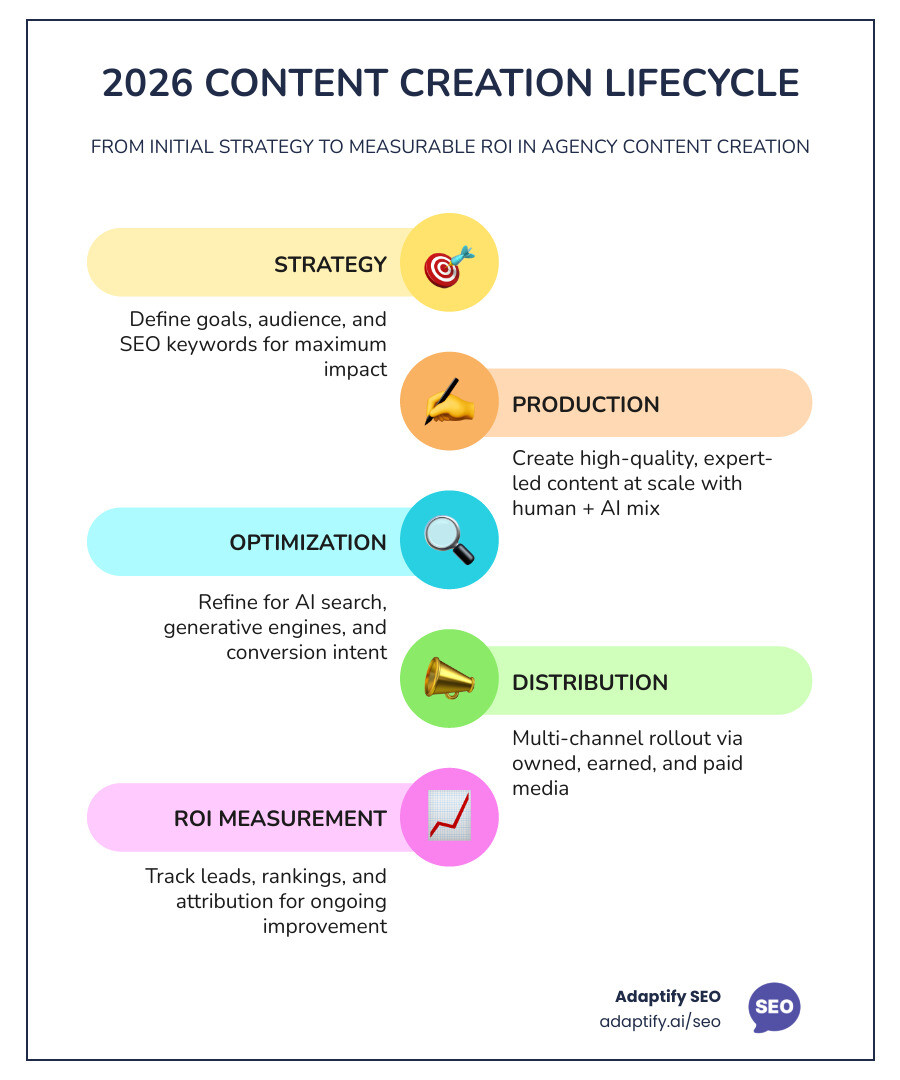

In May 2026, the marketing landscape is noisier than ever. The barrier to entry for creating "okay" content has vanished thanks to basic AI, but the barrier to creating content that actually ranks and converts has moved higher. This is where professional agency content creation steps in.
Unlike an in-house team that might be bogged down by internal politics or a limited perspective, an agency brings a "factory" mindset to the table. They aren't just writing blog posts; they are building Automated Content Creation for Modern Agencies | Adaptify SEO systems that integrate with your broader business goals.
The most common reason I see for outsourcing is the "execution gap." You have a strategy, but you lack the hands to build it. Research from the Content Marketing Institute shows that 70% of B2B marketers say content creation is their top priority, yet many struggle with consistency.
By partnering with an agency, you gain:
If you are currently struggling to keep your blog or social channels active, you might need to look into Your Ultimate Guide to Finding Professional Web Content Creation Services to bridge that resource gap.
A freelancer is a tactical resource; an agency is a strategic partner. While a freelancer might give you a great 800-word article, an agency provides:
Choosing between the two depends on your scale. If you're just starting, a freelancer is fine. If you're ready to build a "content machine," you need the structured approach found in Your Definitive List: The Best Content Production Companies & Services.
Scaling isn't about working harder; it's about building better systems. In 2026, agency content creation has moved beyond simple "copywriting" into full-funnel demand generation. Modern agencies offer a "Demand Team" model that integrates SEO, creative, and distribution experts.
The "Human vs. AI" debate is over - the winners in 2026 are using both. I've seen agencies use AI to handle the "heavy lifting" of research, sitemap cleanup, and initial drafting, while humans focus on the "last mile" of storytelling, brand voice, and fact-checking.
One popular approach is the "Barbell Strategy":
For a deeper dive into this balance, I recommend checking out The AI Content Strategy Playbook: Smart Moves for Smarter Content.
Search is changing. With the rise of AI-powered search engines (GEO/AEO), simply ranking #1 for a keyword isn't enough. Your content needs to be "answer-ready." Agencies are now optimizing for "helpfulness" and "authority" rather than just keyword density.
This involves:
Staying ahead of these shifts is critical, which is why I always suggest a Future-Proof Your Agency: A Guide to AI-Powered SEO.
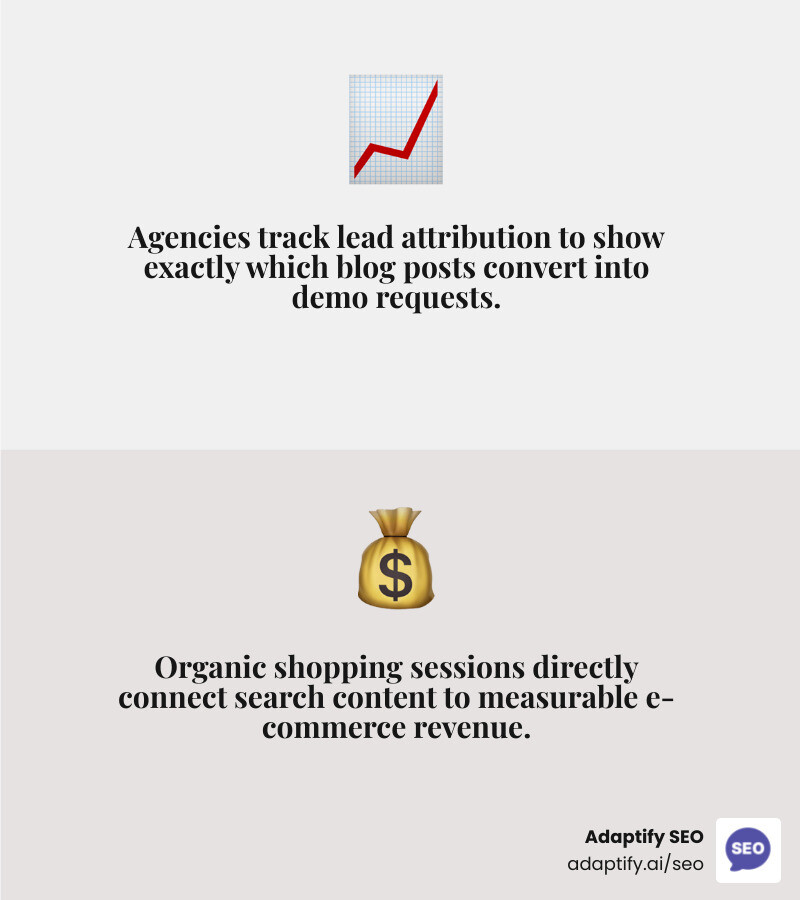
If you can't measure it, you can't scale it. Agencies today use sophisticated reporting to prove that agency content creation isn't just a cost center - it's a revenue driver.
How much does this cost? In 2026, we see three main models:
For more details on how to structure these deals, see The Ultimate Guide to SEO for Agencies.
Agencies use proprietary AI reporting to show more than just "clicks." They track:
To manage all these moving parts, agencies rely on From Brainstorm to Broadcast: The Essential Content Creation Management Software List to ensure nothing falls through the cracks.
Choosing an agency is a high-stakes decision. You aren't just buying words; you're buying a partner who will represent your brand to the world.
Don't hire a generalist for a specialist's job. If you are a B2B SaaS company, you need an agency that understands the "Product-Led Growth" model. Look for:
The best agencies act as an extension of your team, often using Beyond Manual: A Guide to Automating Blog Content for Scale to keep the "factory" running while they focus on high-level strategy.
The ultimate goal of agency content creation is to build a "Content Factory." This means having a repeatable workflow where:
You can learn how to build this for your own business in The Content Factory: Building a Scalable Content Creation Machine.
Top agencies use a "tiered" approach. They use AI to scale foundational, SEO-driven content (quantity) while reserving their best human writers for "hero" pieces like white papers and thought leadership (quality). This ensures they hit traffic goals without sacrificing brand authority.
B2B agencies focus on long sales cycles, education, and lead generation, often using LinkedIn and SEO blogs. B2C agencies, especially social-first ones, prioritize "scroll-stopping" visuals, influencer collaborations, and short-form video on platforms like TikTok and Instagram to drive immediate impulse buys.
Creation is only half the battle. Modern agencies include distribution in their retainers, which includes organic social posting, paid amplification, email newsletter integration, and PR link building to ensure the content actually reaches the target audience.
Scaling an agency in 2026 requires moving away from manual, "one-off" content tasks and toward a systematic approach. Agency content creation provides the bridge between where you are now and where you want to be - a high-growth, high-efficiency business.
At Adaptify SEO, we specialize in helping agencies scale by automating the most time-consuming parts of the process. From strategy formulation to high-quality content production and PR link building, our AI-powered platform acts as your silent partner in growth.
By reducing the manual effort of SEO and content, you can focus on what you do best: building relationships and closing deals.
Ready to stop the manual grind? Start scaling your agency with automated content and SEO today.
Set up automated SEO monitoring for 2026 success: track AI rankings, solve challenges, and boost ROI with top tools like SEO Radar.

Discover the best geo tools for ai search visibility 2026 and boost your brand's AI presence.

Discover how ai visibility experts for geo optimization boost your GEO score with the 4-pillar framework and proven strategies.
Join 1,000+ agencies already delivering SEO and AI visibility from a single platform without increasing their headcount.Join 1,000+ agencies already delivering SEO and AI visibility from a single platform without increasing their headcount.