The Future is Now for SEO Agencies: AI Insights You Can't Ignore

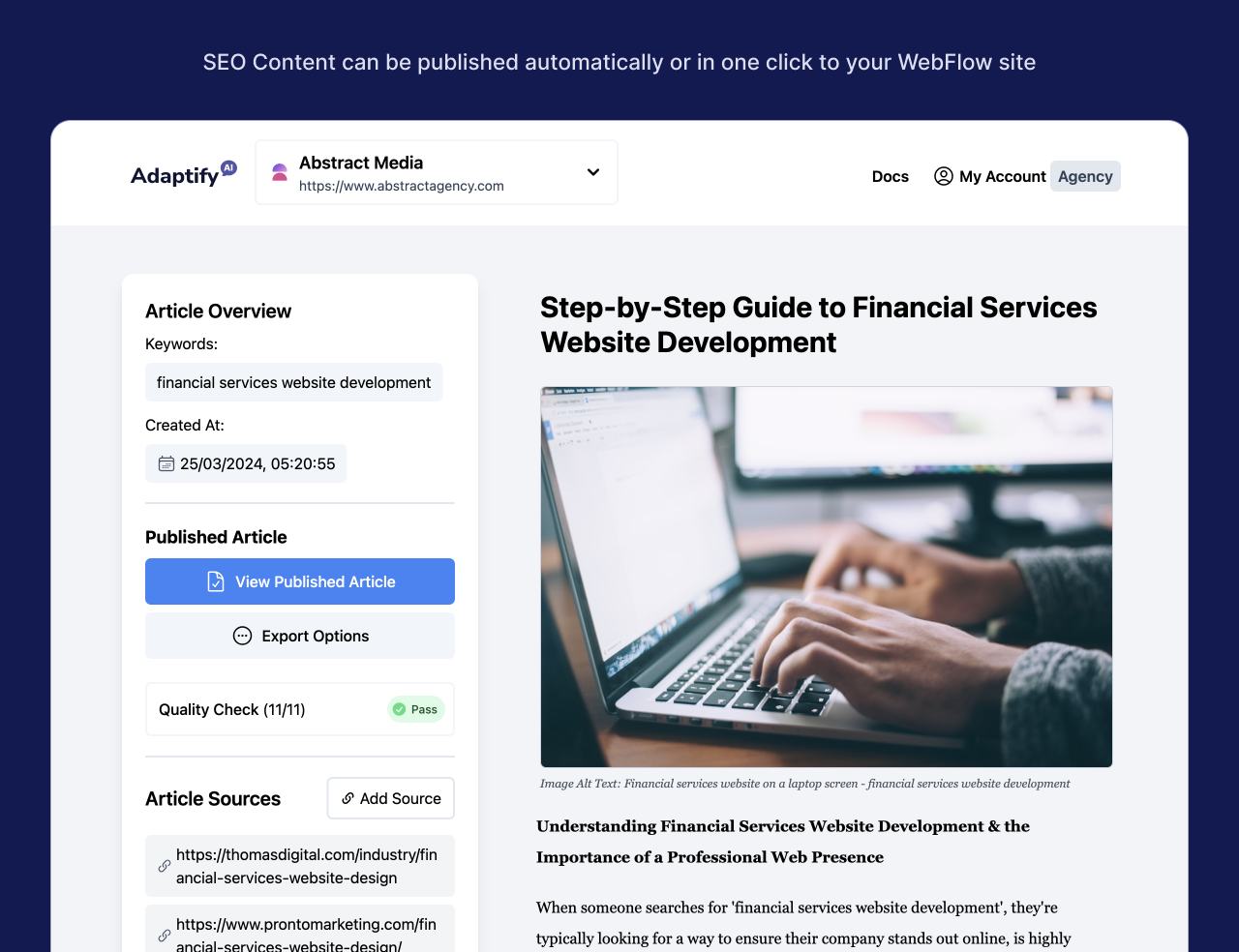


AI-driven insights services for SEO agencies are specialized tools, platforms, and methodologies that use machine learning and large language models (LLMs) to automate data analysis, surface competitive opportunities, and optimize content for both traditional search and AI-generated answers across platforms like ChatGPT, Perplexity, and Gemini.
Here is a quick overview of what these services typically include:
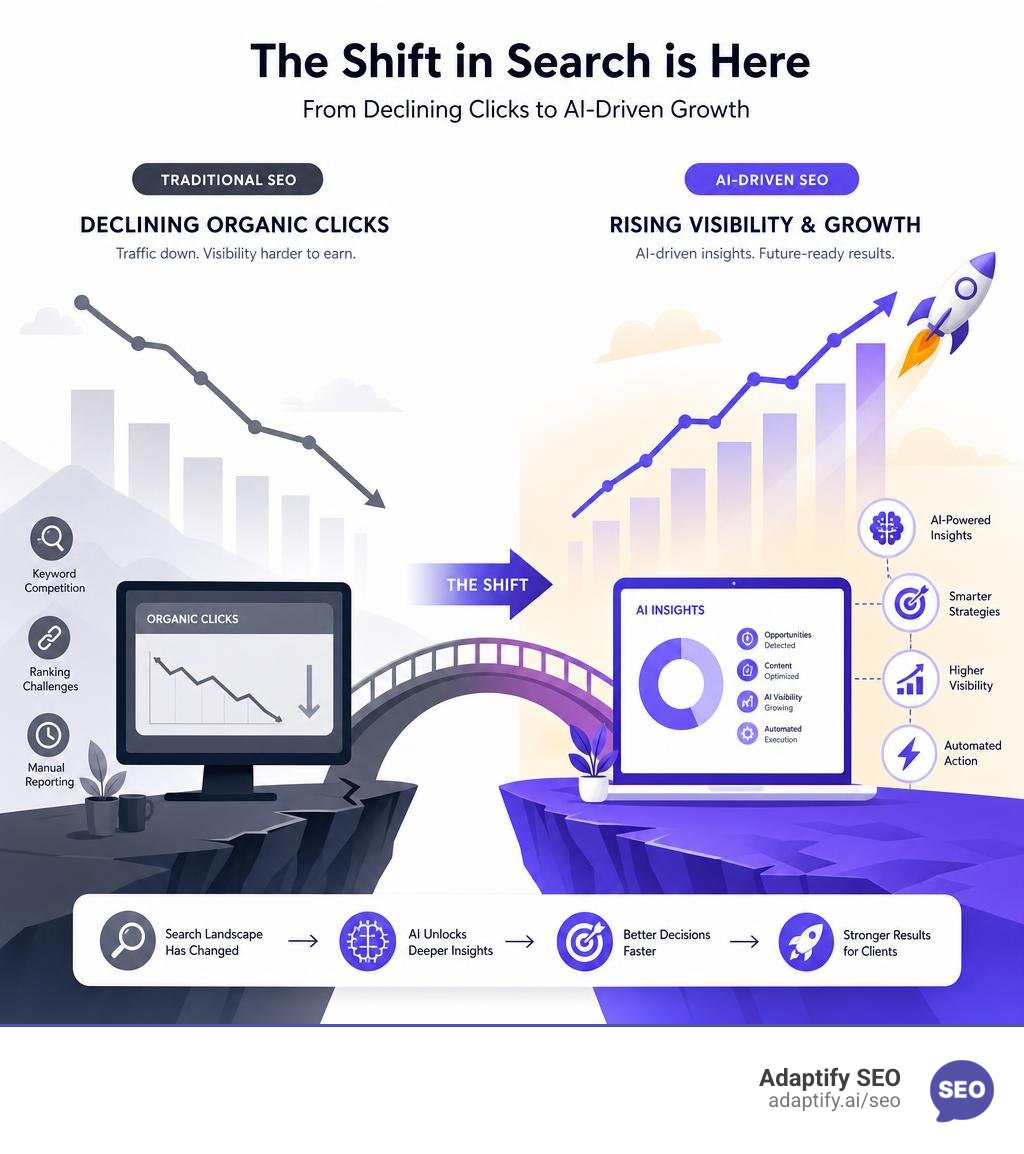
The search landscape has changed fast. AI Overviews now appear in over 65% of Google searches. A Search Engine Land study predicts an 18% to 64% decline in organic clicks as generative search takes hold. Many agency owners are already watching client traffic drop 20–40% with no clear fix in sight.
The old playbook — rank on page one, drive clicks, repeat — is under real pressure. Agencies that stick to it exclusively are leaving their clients exposed.
This is not a future problem. It is a right-now problem.
I'm Hansjan Kamerling, a product designer and marketing consultant who has worked with AI-driven SaaS platforms and data analytics tools — including a platform with 40,000 users built on custom-trained AI models — giving me a grounded perspective on how ai-driven insights services for seo agencies actually work in practice, not just in theory. In the sections below, I'll walk you through the specific services, tools, and strategies that are helping agencies scale results for clients in the age of AI search.
For years, my daily routine as an SEO consultant looked like a endless cycle of exporting CSVs, running manual VLOOKUPs, and staring at dashboards. We used traditional tools to answer one basic question: "What happened?"
But in June 2026, knowing what happened last week is no longer enough. The search ecosystem has evolved past simple keyword matching. Today, search engines evaluate meaning, context, and relationships. To keep pace, agencies are adopting ai-driven insights services for seo agencies to shift from reactive reporting to proactive execution.
Traditional SEO tools only show you the symptoms — like a sudden drop in rankings. AI-driven insights, however, act as a cognitive layer on top of your data. By utilizing predictive analytics and machine learning, these services analyze your entire search ecosystem in seconds. Instead of just flagging a problem, they explain why it happened, what it means for your client's bottom line, and exactly what steps you should take next.
This evolution represents a massive advantage. When you leverage machine learning, you can crawl, analyze, and map semantic relationships across thousands of pages in under a minute. This level of speed allows your team to focus on high-level strategy rather than getting bogged down in manual audits. If you want to dive deeper into how this transition is reshaping our industry, check out my thoughts on The AI Advantage: Adapting Your SEO for the Generative Era.
To understand why these services are so transformative, we have to look under the hood. The core of any modern AI SEO strategy relies on three main pillars:
By offloading the grunt work to an AI agent, your team is freed up to do what they do best: build relationships, understand client business goals, and apply creative nuances that no machine can replicate. This balance is the foundation of scale, as outlined in The Ultimate Guide to SEO for Agencies.
If you run an agency, you might be wondering how to actually sell these capabilities to your clients. The trick is to avoid selling "AI" as a buzzword. Instead, package these capabilities into tangible, high-value services:
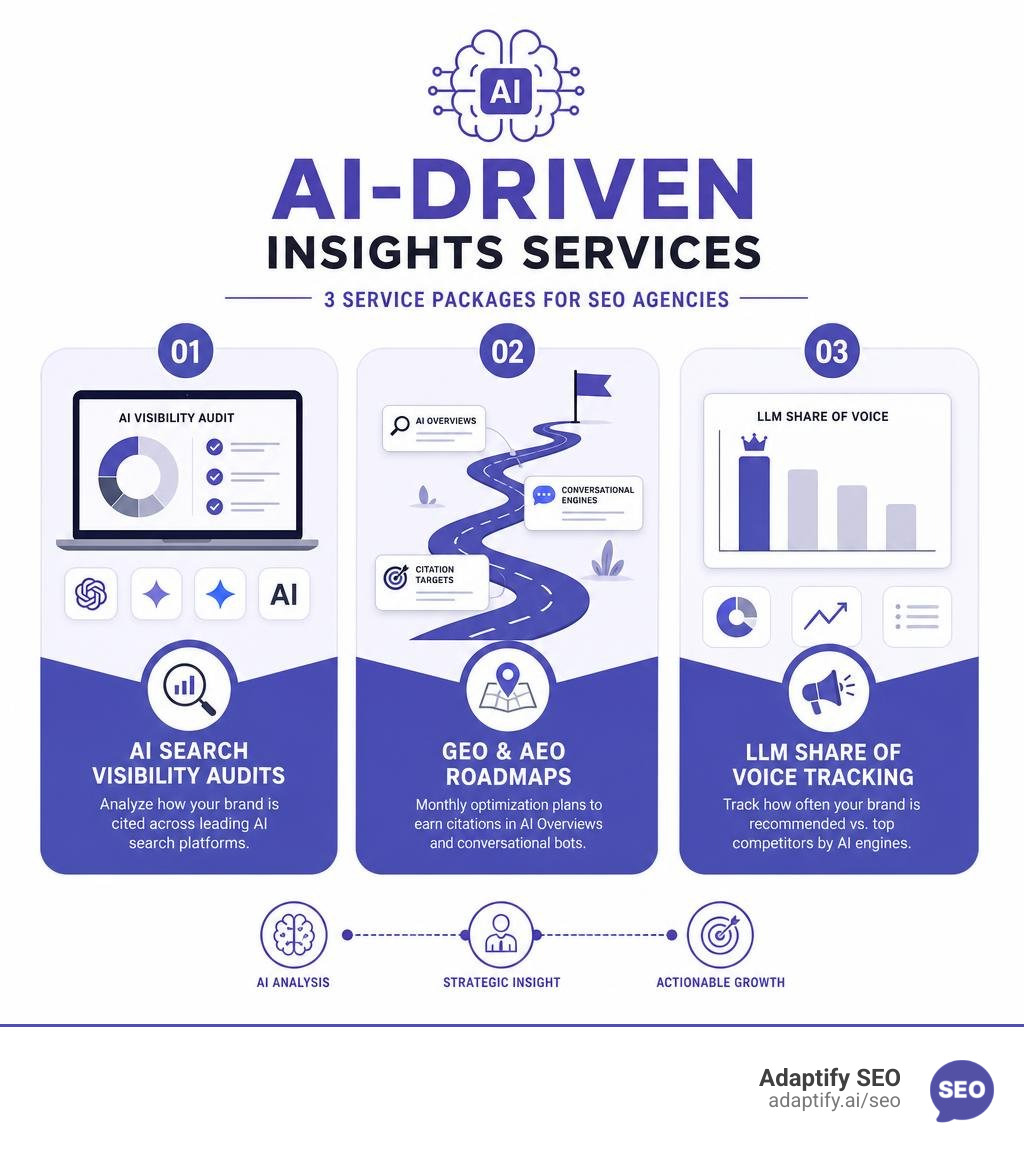
When you deliver these modern insights, having the right reporting structure is critical. You need to present complex AI tracking metrics in a clear, branded format that clients can easily digest. This is where Mastering Client Communication: The Power of White-Label Reporting becomes an essential part of your agency's toolkit.
Let's address the elephant in the room: traditional search traffic is shifting. With ChatGPT reaching 100 million users in record time and Perplexity processing over 500 million queries monthly, users are increasingly getting their answers directly from AI interfaces.
This shift has given rise to two critical frameworks: Answer Engine Optimization (AEO) and Generative Engine Optimization (GEO).

To win in 2026, your agency needs to understand how these optimization games differ from traditional search. Here is a quick breakdown:
| Feature / Metric | Traditional SEO | Answer Engine Optimization (AEO) | Generative Engine Optimization (GEO) |
|---|---|---|---|
| Primary Goal | Rank in top blue links on SERPs | Appear as the direct answer in featured snippets / AI Overviews | Be cited as a trusted source in conversational LLM responses |
| Key Optimization Focus | Keyword density, backlinks, metadata | Structured Q&A, schema markup, natural language | Authority chains, unique data, semantic relevance, E-E-A-T |
| User Search Behavior | Short, fragmented queries (e.g., "best CRM") | Conversational questions (e.g., "What is the best CRM for small agencies?") | Iterative, multi-turn prompts (e.g., "Compare option A and B based on my budget") |
| Success Metric | Organic impressions and click-through rate | Direct impressions, answer citations | Citation frequency, LLM Share of Voice, referral traffic |
If you want an LLM like ChatGPT or Gemini to recommend your client’s product, you can't just hope the model stumbles across their homepage. You have to make it incredibly easy for the model's scraper to extract and trust your data. This is where citation engineering comes into play.
First, you must implement comprehensive schema markup. By attaching deep JSON-LD schemas (such as Article, FAQPage, HowTo, and Organization markups), you provide machine-readable context that search engines use to build their knowledge graphs.
Second, you need to establish strong entity mapping. LLMs cross-reference data across multiple authoritative sources to verify facts. If your client is mentioned on trusted industry directories, cited in high-authority media outlets, and has a clean, structured website, the LLM is far more likely to cite them as a primary recommendation. To understand how this fits into the broader picture of natural authority, take a look at Beyond the Buzzwords: A Guide to Natural vs. Organic SEO.
Optimizing content for generative engines requires rewriting the classic copywriting playbook. LLMs do not read content the way humans do; they look for patterns, authority, and conciseness.
To optimize your content strategy for GEO, implement these best practices:
By focusing on high-quality, authoritative content rather than keyword stuffing, you naturally align with what both Google and LLMs look for. If you want to scale this content process without sacrificing quality, check out AI-Powered SEO: Automate Your Way to the Top.
The primary bottleneck for any growing SEO agency is labor. Between keyword research, technical audits, content writing, and link building, a standard client retainer can quickly consume your team's entire week. This manual overhead limits your capacity to scale and squeezes your profit margins.
By integrating ai-driven insights services for seo agencies, you can automate these repetitive tasks and significantly lower your operational costs.
For example, a complete site crawl and technical audit that used to take an analyst hours can now be completed in under 60 seconds. Instead of just exporting a list of broken links, an AI agent can automatically write the necessary schema markup, suggest internal links, and prepare code fixes for your review. This shift from simple diagnostics to automated execution is a game-changer for agency margins. To learn how to implement these systems, read Automated SEO Reporting: The Secret Weapon for Agencies.
Keyword research has traditionally been a guessing game of search volume and keyword difficulty. AI-driven insights change this by analyzing search intent and competitive gaps at scale.
Rather than looking at keywords in isolation, AI platforms group search queries into semantic clusters. This allows you to identify entire topical areas where your competitors are weak. You can quickly discover high-intent, low-competition long-tail keywords that match exactly what buyers are searching for.
Once these gaps are identified, the AI can automatically generate detailed content briefs, outline semantic hierarchies, and map out a 30-day content calendar designed to build topical dominance. Managing these complex workflows becomes simple when you use a centralized hub, as discussed in Your SEO Command Center: Mastering Tasks with a Management Platform.
While the benefits of AI automation are clear, the transition isn't always seamless. One of the biggest hurdles agencies face is voice drift — where automated content begins to sound generic, robotic, or inconsistent with the client’s established brand.
To overcome this, top-tier AI platforms use advanced brand voice extraction. By analyzing 30 to 50 existing pages of a client's website, the system builds a unique "voice fingerprint." This ensures that any outline, brief, or draft generated matches the client's tone, reading grade, and style guidelines.
Additionally, implementing a deterministic scoring model is essential. Before any content is published, it should be scored against a set of quality gates — checking for brand-mention caps, source diversity, and formatting. This ensures your content remains helpful and compliant with search engine guidelines. For a step-by-step guide on building this framework, see Beyond the Buzz: How to Formulate a Winning AI Strategy.
If your agency is still relying solely on traditional keyword rank trackers to prove value, you are missing a massive piece of the puzzle. In 2026, a client might rank #1 for a high-volume keyword but still see a drop in traffic because Google's AI Overview or a Perplexity answer is capturing the click.
To demonstrate real ROI, you must measure your LLM Share of Voice and AI Citation Frequency.
According to the Salesforce State of Marketing Report on AI adoption, high-performing marketing teams are rapidly shifting their KPIs toward real-time visibility metrics and multi-platform brand presence. Showing your clients how often they are cited as a trusted source in conversational answers is the new gold standard of SEO reporting.
To measure your visibility in generative search, you need to track how LLMs respond to conversational buyer queries.
This process involves running automated, recurring "buyer prompts" across ChatGPT, Claude, Gemini, and Perplexity. The AI tool records:
By aggregating this data over time, you can present your clients with a clear "AI Share of Voice" metric. This proves that your optimization efforts are keeping them top-of-mind where their customers are actually searching. For more on future-proofing your metrics, read Future-Proof Your Agency: A Guide to AI-Powered SEO.
Tracking citations is great, but clients ultimately care about conversions and revenue. This makes attribution a critical focus for modern agencies.
Fortunately, platforms like Google Analytics 4 (GA4) can be configured to segment referral traffic from AI engines like ChatGPT, Perplexity, and Gemini. By isolating this traffic channel, you can measure:
Often, you'll find that traffic coming from AI citations is highly qualified, leading to higher conversion rates because the user has already been pre-filtered by the LLM's recommendation. Proving this connection requires a deep understanding of search mechanics, which is why having an expert in your corner is so valuable, as explained in The Brains Behind the Bots: Why You Need an AI SEO Consultant.
No. While AI is incredibly efficient at analyzing massive datasets, identifying keyword gaps, and automating technical fixes, it lacks the creative and strategic thinking of a human specialist.
The best results come from a collaborative approach: AI handles the heavy data processing, while human experts focus on high-level strategy, client relationships, and creative storytelling.
AI Overviews and zero-click searches have undoubtedly reduced traditional organic click-through rates for informational queries. However, they have also created a brand-new stream of highly qualified referral traffic.
When a user clicks a citation link inside an AI Overview or a ChatGPT response, they are typically much closer to a purchase decision, resulting in higher conversion rates for the cited brands.
While both focus on non-traditional search, they target different engines. Answer Engine Optimization (AEO) optimizes content for direct, concise answers in search engine features like Google's featured snippets and AI Overviews.
Generative Engine Optimization (GEO) focuses on the broader logic of large language models, optimizing your content's authority, E-E-A-T, and semantic structure so conversational bots like ChatGPT and Perplexity cite your brand as a trusted source.
The search landscape in June 2026 is vastly different from the one we knew just a few years ago. With generative search redefining user behavior, agencies must adapt or risk falling behind. Embracing ai-driven insights services for seo agencies is the most effective way to protect your clients' visibility and scale your agency's operations.
At Adaptify.ai, we build automated SEO services specifically designed for modern agencies. Our platform streamlines everything from initial strategy formulation and deep semantic keyword research to content creation and high-authority PR link building. By handling the manual heavy lifting, we help you deliver exceptional client results while keeping your overhead low.
Ready to future-proof your agency and unlock new margins? Explore our pricing plans or get started with Adaptify's automated SEO services today.
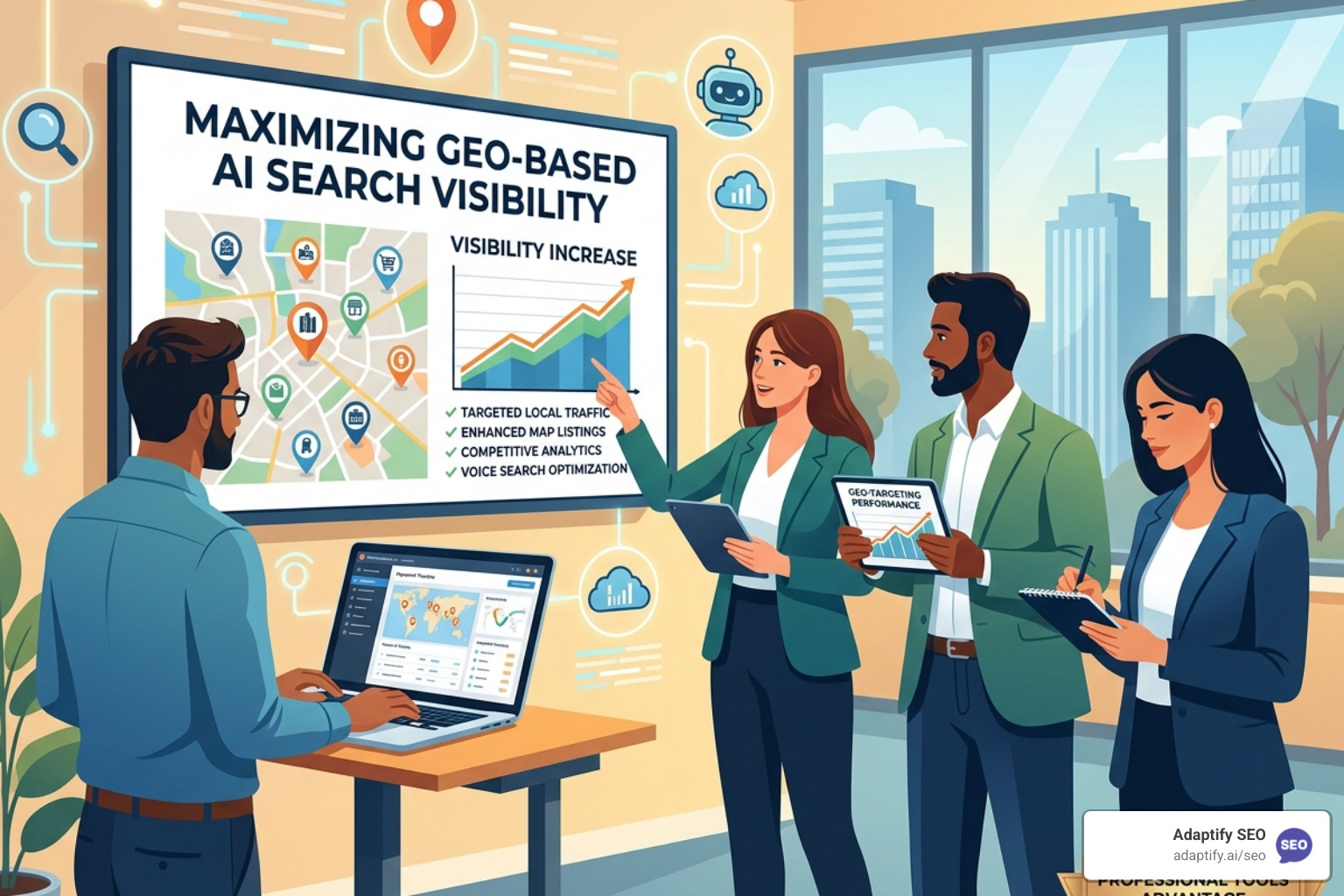
Discover benefits of professional tools for geo-based ai search visibility. Automate tracking, boost citations & outpace manual efforts in...

Master SEO business development to win clients, close deals, and scale your agency with proven strategies and AI-powered tactics.
Discover B2B SEO services for sustainable growth. Master strategies, ROI measurement, and AI shifts to generate qualified leads from searc...
Join 1,000+ agencies already delivering SEO and AI visibility from a single platform without increasing their headcount.Join 1,000+ agencies already delivering SEO and AI visibility from a single platform without increasing their headcount.