Going Hyperlocal: The Ultimate Guide to Modern Local SEO Trends


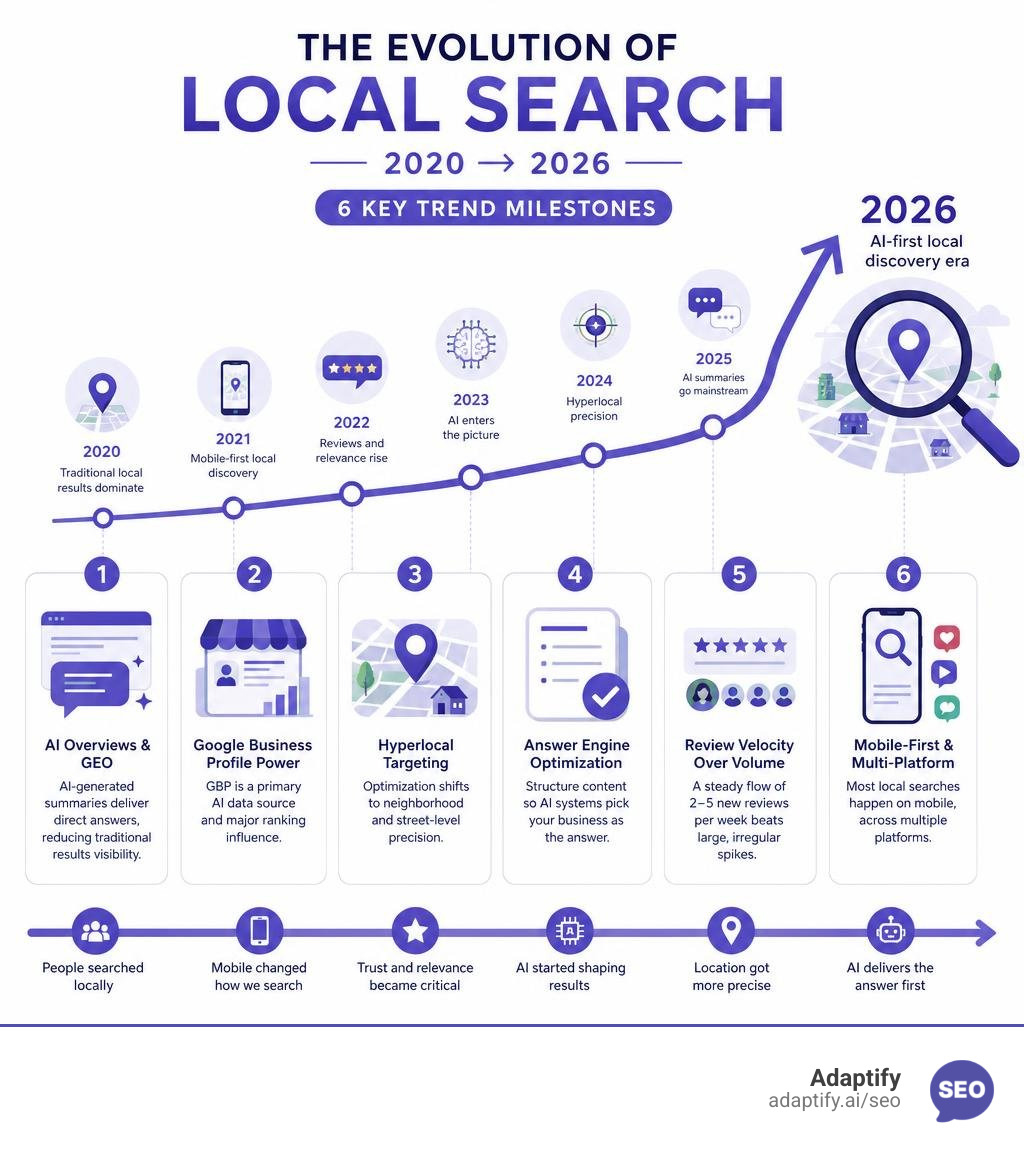
The most important local SEO trends shaping search visibility in 2026 are:
Local search has always been competitive. But in 2026, the rules have changed in a fundamental way.
For most of the last decade, showing up in local search meant one thing: rank in the Google Map Pack. Get three listings to appear. Win the click. That model is collapsing.
Today, AI-powered search engines — Google's AI Overviews, ChatGPT Search, Perplexity, and Gemini — are synthesizing local recommendations before a user ever sees a traditional results list. A business can rank on page one of organic search and still lose the lead because an AI overview surfaced a competitor first.
The numbers make the stakes clear. 46% of all Google searches have local intent. 76% of people who search for something nearby visit a business within 24 hours. And 27.2% of U.S. search traffic is now zero-click — meaning users get their answer directly from the search results page without ever visiting a website.
This is not a minor update cycle. It is a structural shift in how local discovery works.
At the same time, mobile dependency is deeper than ever — 91% of U.S. adults own a smartphone, and 78% of local mobile searches result in an offline purchase. Meanwhile, younger consumers are starting their local searches on TikTok, Instagram, and Reddit, not just Google.
For agency owners managing local SEO at scale, this creates a real pressure point: the tactics that worked in 2023 are not enough to win in 2026. The playbook needs updating — fast.
I'm Hansjan Kamerling, a product designer and marketing consultant at Adaptify AI, where I help agencies build scalable systems that stay ahead of fast-moving local SEO trends — the same kind of compounding shifts I've navigated across SaaS platforms, fintech startups, and digital products reaching millions of users. In this guide, I'll walk through the six most important local SEO developments shaping search right now, and exactly what you can do about each one.
To understand where local search is going, we first have to look at how search engines themselves have transformed. Google's core local ranking algorithm still relies on three pillars: Relevance, Distance, and Prominence. However, the way search engines evaluate these pillars has changed.
Historically, relevance was about matching keyword density on a page. Today, search engines use advanced neural networks to understand semantic intent and verify real-world entity authority. Rather than looking for a business that has stuffed "best plumber in Boston" into its footer fifty times, search systems analyze whether a business is a verified, trusted entity with consistent data across the web.
With zero-click searches climbing to over 27% of all search traffic, users are no longer browsing through ten blue links. They want immediate, highly accurate answers. This means local discovery has moved from "earning the click" to "earning the citation." If your clients' businesses are not structured as clear, machine-readable entities, they simply will not exist in the eyes of modern search tools.
With 43% of local searches now triggering AI Overviews, the organic landscape has shifted. AI search engines do not just list options; they run parallel retrievals across web pages, reviews, maps, and social signals to synthesize a direct recommendation.
This has given rise to Generative Engine Optimization (GEO). GEO is the practice of optimizing your digital footprint so that Large Language Models (LLMs) trust your business enough to cite it as a recommended source. AI engines are highly risk-averse; they prioritize businesses with stable, verified facts to avoid recommending a closed or fraudulent merchant.
To capture these high-value AI citations, agencies must move beyond traditional keyword optimization. You can read more about this fundamental shift in our guide on Local SEO Is Dead, Long Live GEO: Boosting Local Visibility in AI.
To dominate AI-driven local search, you need to structure your clients' websites with clean, structured schema markup and answer-first content that AI models can easily parse and reference.
If you think of a business's website as its digital home, in 2026, its Google Business Profile (GBP) is its primary data feed for AI. GBP signals now account for 32% of all Local Pack ranking influence.
Google's AI layer constantly cross-references the claims made on a business's website with its GBP details in real time. If your website schema lists closing hours as 6:00 PM, but your GBP profile says 8:00 PM, the AI detects this inconsistency as a risk and may exclude the business from conversational search results entirely.
Furthermore, specific GBP optimization factors have skyrocketed in importance:
To keep your profiles optimized and monitor how these shifts impact your visibility, refer to our walkthrough on Google Business Profile Tracking: How to Monitor Your Local Search Success. For a deeper look at what actually moves the needle in the current algorithm, explore the analysis of Local SEO Ranking Factors in 2026: What Actually Moves the Needle.
The traditional, broad-reaching "city-wide" SEO strategy is losing its effectiveness. AI search has compressed the Map Pack, often synthesizing ten potential candidates down to one or two highly precise recommendations. This is hyperlocal SEO.
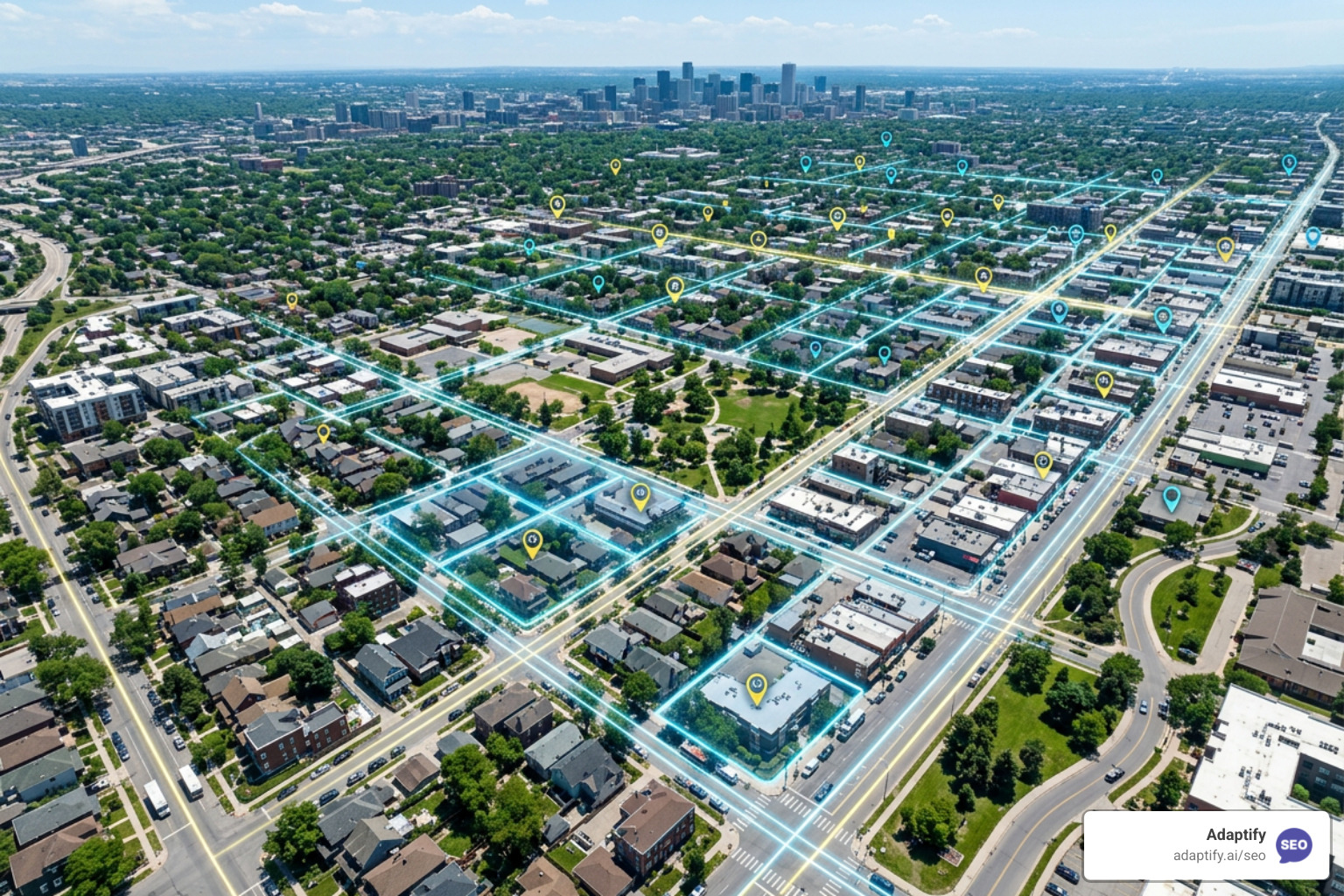
Hyperlocal SEO operates at the neighborhood, block, and street level. Instead of targeting generic terms like "Boston dentist," businesses must optimize for specific landmarks, transit stops, and neighborhood-specific landing pages.
A common pitfall for multi-location or service-area businesses is cloning a single page and swapping out the city names. This creates index bloat and active quality penalties. Instead, businesses must build genuine, unique location-specific landing pages with embedded Google Maps, localized customer reviews, and neighborhood-specific content.
To track how your rankings shift block-by-block, you need modern tracking methodologies. Learn how to map this out in our guide on Local Rank Tracking: The Secret Sauce for Hyperlocal Visibility.
58% of consumers have used voice search to find local business information, and 50% use it daily. Spoken queries are fundamentally different from typed searches; they are longer, conversational, and highly specific.
Instead of typing "plumber Dallas," a user will ask Siri or Alexa: "Who is the best plumber near me open now who can fix a water heater leak?"
This shift requires Answer Engine Optimization (AEO). While traditional local SEO focuses on map visibility, AEO focuses on getting selected as the single, definitive answer by voice assistants and AI engines. Because voice search typically yields only the single best result, ranking first is critical—lower positions simply will not be read aloud.
To capture these conversational queries:
For a comprehensive look at how to align your content with these conversational patterns, explore The Ultimate Guide to Local SEO Strategies.
Online reviews have evolved far beyond a static trust badge. Today, 87% of consumers read online reviews for local businesses, and 89% expect business owners to respond.
However, search engines no longer just look at your total review count. AI engines now analyze review sentiment, specific keywords used within reviews, and—most importantly—review velocity (the consistency with which you acquire new reviews).
| Metric | Review Volume (Old Way) | Review Velocity (2026 Trend) |
|---|---|---|
| Primary Focus | Total number of reviews on the profile. | Consistent, steady stream of new reviews. |
| AI Evaluation | Treated as a vanity metric; easily manipulated. | Viewed as a proxy for active, trusted business operations. |
| Target Cadence | One-time campaigns gathering 50+ reviews. | Earning 2 to 5 highly detailed reviews every week. |
| Search Engine Impact | Moderate historical ranking weight. | High ranking weight; directly influences AI Overview citations. |
AI systems actively read the actual text of customer reviews to verify if a business actually performs the services listed on its website. If a customer writes, "They did an amazing job repairing my ductless mini-split AC in Quincy," Google's AI connects the service, the location, and the positive sentiment to boost the business's topical authority.
To build a sustainable review strategy that drives real ranking growth, dive into Local SEO Help: The Ultimate Guide to Dominating Your Neighborhood Search.
Mobile optimization is a non-negotiable foundation of local search, with 64% of all local searches conducted on mobile devices. Google's mobile-first index is the primary index, meaning slow, poorly formatted mobile sites are actively penalized.
At the same time, local discovery is fragmenting. Gen Z consumers use an average of 3.6 platforms before making a purchase decision, and 73% of consumers use social media during their search for local businesses.

A significant portion of local search now happens outside of Google:
Optimizing for this multi-platform landscape means maintaining absolute NAP (Name, Address, Phone) consistency across not just Google, but also Apple Business Connect, Bing, Yelp, Facebook, and niche directories. For a step-by-step approach to building this multi-channel foundation, check out Cracking the Local Code: A Beginner's Guide to SEO Success.
Navigating the fast-moving current of local SEO trends in 2026 requires more than manual updates and outdated keyword tactics. It requires a systematic, scalable approach to entity management, schema implementation, content creation, and multi-platform tracking.
For agencies managing dozens or hundreds of local clients, doing this manually is a recipe for operational bottlenecks. That is where Adaptify.ai comes in.
Adaptify offers an automated SEO solution built specifically for agencies. By streamlining time-consuming processes like local keyword strategy formulation, schema-optimized content creation, and high-quality PR link building, Adaptify allows your agency to deliver cutting-edge local search and GEO performance with minimal manual effort.
If you're ready to scale your agency's local search offerings and ensure your clients dominate both traditional Map Packs and modern AI answer engines, Explore Adaptify's AI Visibility Features today.
Master the best local SEO strategies to rank higher in Google Maps and drive more local customers in 2026.
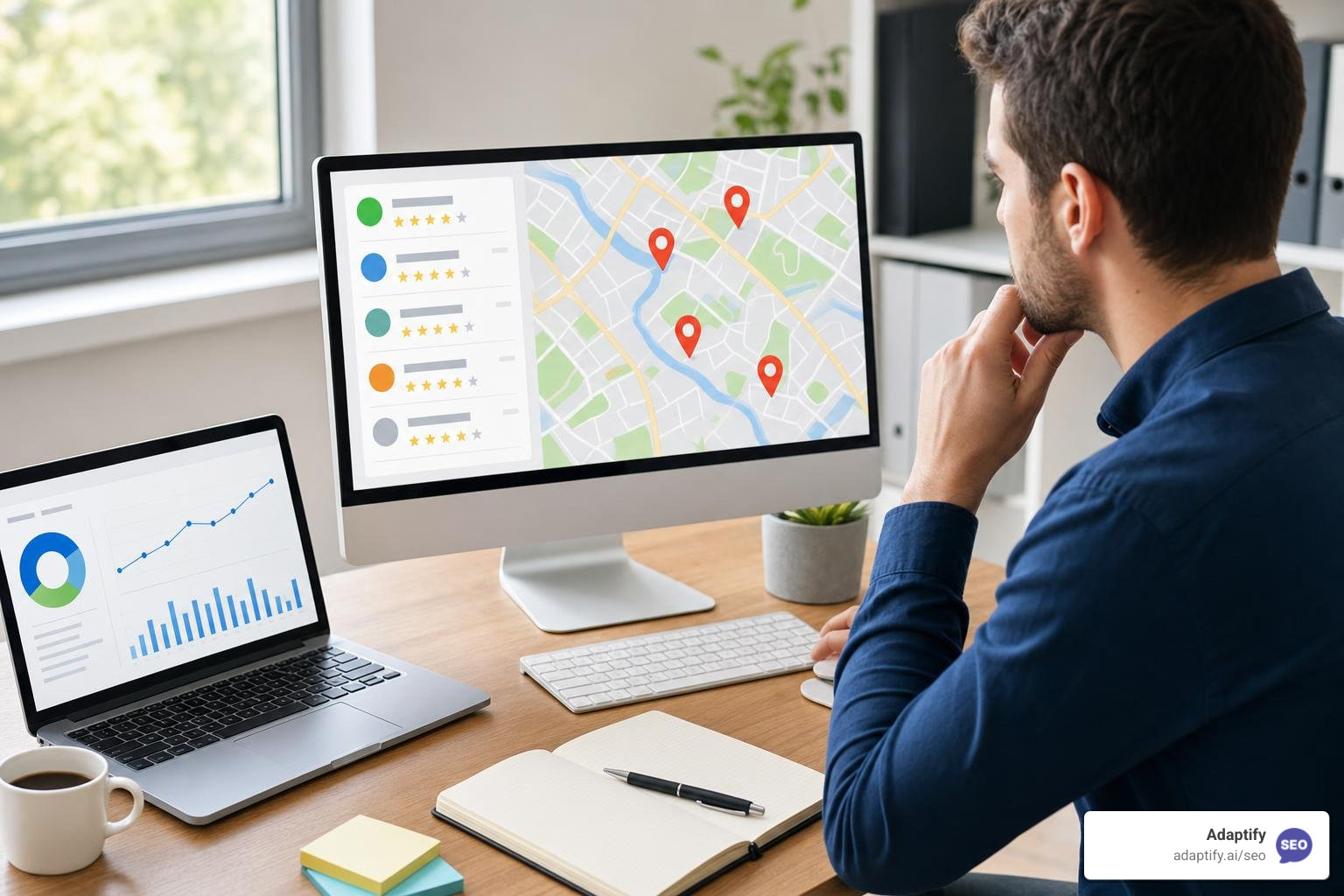
Get help with local SEO to rank higher in Google Maps and dominate neighborhood search results.

Compare health insurance for entrepreneurs with ACA plans, tax deductions, and subsidies to protect your business and budget.
Join 1,000+ agencies already delivering SEO and AI visibility from a single platform without increasing their headcount.Join 1,000+ agencies already delivering SEO and AI visibility from a single platform without increasing their headcount.